AI a friend, not foe, for Jamaica’s tourism sector
Originally published by Jamaica Observer Read the original
ARTIFICIAL intelligence (AI) has been cast by many as a job killer and an existential threat, fuelling fears of a future in which machines increasingly dictate how humans live and work.
But for Sandals Corporate University Senior Manager Andre Campbell, the future of tourism looks considerably less frightening as he described a seamless interaction between travellers, AI and resorts as “a perfect world”.
Speaking on Monday during a panel discussion on ‘Agentic Commerce & the AI Booking Journey’ at Jamaica Product Exchange (JAPEX) 2026, Campbell argued that AI could take much of the friction out of planning and booking a holiday while giving tourism workers more room to concentrate on the personal service that defines the Jamaican experience.
Rather than viewing AI simply as a substitute for people, he suggested that its greater value may lie in handling routine processes and using information supplied by travellers to help tourism businesses anticipate their needs.
The idea, he said, is to make the journey from inspiration to booking as effortless as possible.
“I think if an agent is able to make the process frictionless, seamless, effortless, I think it’s a plus… If I can prompt that I need a luxury vacation in the sexy south coast [and] I would love an overwater bungalow with a butler, and it pops up Sandals South Coast, I believe it’s a perfect world,” he said.
Campbell argued that the technology could ultimately create a clearer division between what machines do well and what people do best.
“I think if the agent allows us to book that vacation just exactly how we want it, it then allows the persons on the ground to create those exceptional moments that are going to blow us away, not only at the resort, but in Jamaica on a whole... it would be perfect work for me,” he said.

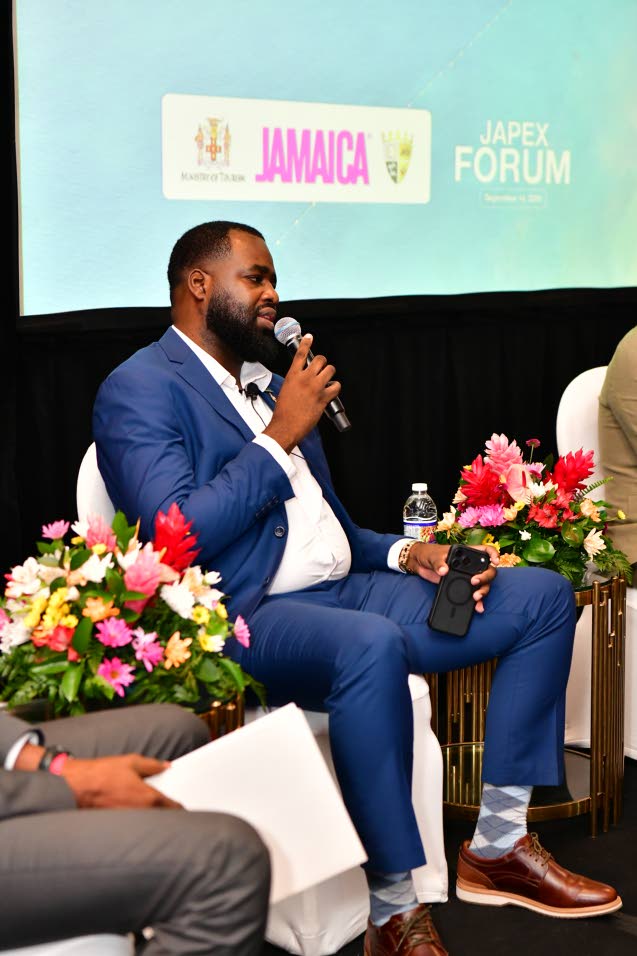
From left: Dr Carey Wallace, executive director, Tourism Enhancement Fund; Andre Campbell, senior manager of learning programmes & innovation, Sandals Corporate University; Dean Challis, managing director/head of media and innovation, Accenture Song; Kristopher DaCosta, marketing manager, Jamaica Tourist Board; and Paul Salmon, chairman and chief executive officer, Rockhouse, participate in a JAPEX 2026 panel discussion on ‘Agentic Commerce & the AI Booking Journey’ at Moon Palace Ocho Rios in St Ann on Monday. (Photo: Aceion Cunningham)
But the growing use of AI also means that tourism workers themselves may have to change how they operate. Campbell said a traveller who voluntarily provides detailed information about their preferences and needs will expect that information to translate into a more personalised experience at the property. That could mean frontline workers spending less time repeatedly asking guests for information, and more time acting on information already available to them. That shift is already taking place at some Jamaican tourism businesses. Paul Salmon, chairman and chief executive officer of Rockhouse Hotel, said his property has been using AI as a practical tool to improve communication with guests and streamline work for employees. Rockhouse developed an AI chatbot with an AI company, initially restricting it to information provided by the hotel and automatically updating it with website rates. Salmon said the system has since evolved beyond simply answering questions and is being connected to other communication channels and business processes. “I think it improves the interaction with our customers. The chatbot we’re working with speaks over 100 languages, it’s available 24-7, so it creates a connectivity with the customer that we might not have easily been able to facilitate previously — which is another great, great positive,” he said. Salmon also pushed back against the idea that AI necessarily means eliminating tourism jobs. Speaking with the Jamaica Observer after the panel discussion, Salmon said the focus at Rockhouse has instead been on using the technology to improve efficiency while freeing employees to spend more time on the aspects of hospitality that require human interaction. “We don’t see it as replacing jobs, we just see it as an opportunity to deliver better customer experiences to our guests, more productivity and efficiency for our team, and be able to spend more time focusing on delivering that human experience and connection with Jamaica that the guests love so much,” he told the Observer. Salmon said AI could also change the nature of the questions travellers ask when searching for accommodation. Intead of broad searches for a “great” hotel in Jamaica, travellers could increasingly use AI to identify properties based on highly specific combinations of requirements. That development could make the booking process more personalised, but it also places greater importance on the accuracy and consistency of information provided by tourism businesses. Kristopher DaCosta, marketing manager at the Jamaica Tourist Board (JTB), said the island’s tourism industry needs to ensure that information about the destination is structured and reliable enough for AI systems to understand. He said the JTB sees an opportunity to develop destination information infrastructure that not only benefits major tourism players, but also smaller businesses which may currently rely heavily on platforms such as WhatsApp or Instagram. DaCosta also warned that inconsistent information could hurt Jamaica when AI systems compare destinations, properties, and prices. “How we control things in this space is really a challenge and... I think it’s one of the biggest fears that we have as an organisation… This infrastructure that we want to build, it’s not a JTB infrastructure, it has to be an all-industry infrastructure because it gives us that robust set of information that is consistent across the board and that is working with our hotel partners, our tourist attractions, but also our airline partners,” said DaCosta.