Caribbean News
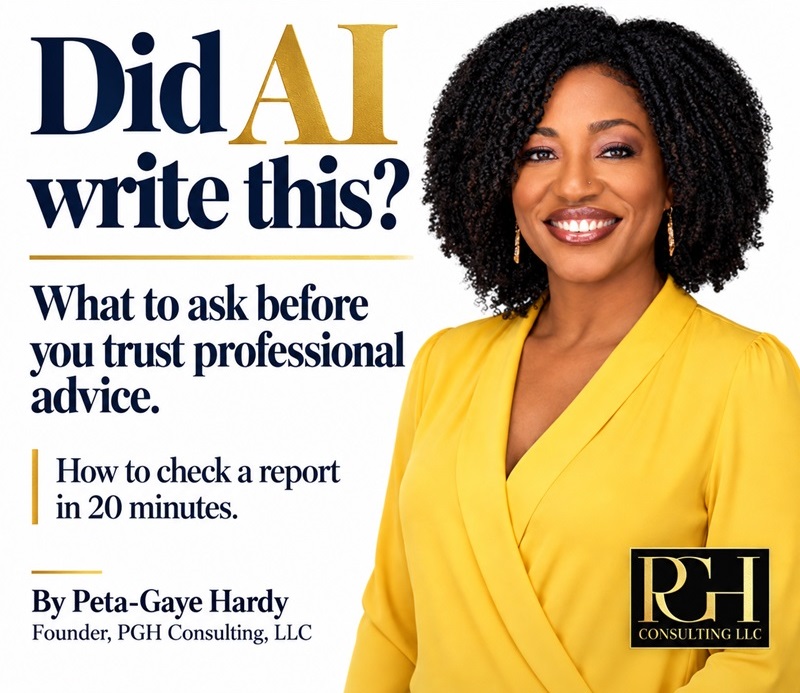
Ask your accountant one question: did AI write this?
Oct 30, 2026 · Peta-Gaye Hardy, Founder, PGH Consulting, LLC
Originally published by Jamaica Observer Read the original
Deloitte Australia wrote a 219-page feasibility study for the Western Australian government on merging three universities, for a fee of A$166,000, about US$117,000. In October, after a critic on a discussion forum flagged what looked like AI-generated citation errors and the Australian Financial Review followed up, the errors were itemised: citations naming the wrong authors, references that did not match the studies they pointed to, a link to an entirely different journal article, and a university repeatedly referred to by a name it dropped in 2010. Deloitte called them “minor referencing errors” and said they did not affect the substantive findings.
Then, on 26 October, Guardian Australia read the appendix. In one scenario the day-one merger costs and the five-year costs that followed added up to A$659 million, and the report recorded A$399 million, a gap of A$260 million. Deloitte said generative AI had been used to “support the collation of research, synthesis of information and editorial proofing.” The state government said it was “extremely disappointed,” asked for expedited cost recovery, and ordered the report reissued.
It is the second time in a year for an Australian government. In 2025 Deloitte produced a A$440,000 review for Australia’s employment department that cited academic papers which did not exist and quoted a federal judge in a passage she never wrote. The revised version disclosed that a generative AI system, Azure OpenAI, had been used in its creation, and Deloitte repaid the final instalment, reported at over A$97,000.
Nobody reading this is commissioning a merger study. But most readers pay an accountant, a lawyer, an auditor or a consultant, and all of them are using the same tools. The question is whether you will know, and whether anyone checked.
AI errors have a shape: fake references (real author, wrong paper), convenient quotes, totals
that do not foot, stale names, and a confident summary whose polished wording does not prove the
arithmetic was done. A good sentence is not a checked source. (Branded graphic by PGH Consulting, LLC)
The errors have a shape
In the Datarails survey this column cited three weeks ago, 75 per cent of finance leaders named lack of auditability as the top reason they hesitate to trust AI tools. The Deloitte reports show what that looks like on paper, and the pattern is consistent enough to be useful.
AI tools do not make the mistakes a tired junior makes. A junior transposes a digit. A language model produces something that looks exactly like evidence and is not: a real author on the wrong paper, a real journal with a fabricated article, a judge’s name on a quotation that fits the argument perfectly because the tool wrote it to fit. The researcher who found the Canberra errors said of one cited book that he knew at once it was “either hallucinated by AI or the world’s best kept secret.” The tell was not that they were wrong. It was that they were too convenient.
Numbers go wrong differently. A model summarising a table will state a total with confidence, and if the total was never computed from the table it will be a plausible figure rather than the right one. That is how an appendix ends up A$260 million short of its own components. The sentence reads well. The arithmetic was never done.
Courts have seen the pattern for two years. A US appeals court fined two lawyers US$15,000 each in March for briefs containing more than two dozen fake citations and misstatements of fact, noting that “smaller fines have plainly been inadequate”; the court did not establish how the citations were produced. Closer to home, a Trinidad High Court judge referred two attorneys to the disciplinary committee last year for citing cases that did not exist, and the Bahamas Supreme Court did the same in August 2025 after counsel admitted ChatGPT had supplied three non-existent authorities.
Jamaica already has a rule for lawyers
In September 2025 the Chief Justice issued Practice Direction No. 1 of 2025 on the use of generative AI in court proceedings. It requires that any document prepared with AI assistance be “thoroughly reviewed, verified, and approved by the party or attorney submitting them,” that it “must not contain fabricated case law, misapplied authorities, or hallucinations,” and that the attorney maintain “professional responsibility for all materials filed or submitted.” A declaration of AI use must be attached. Non-compliance can be treated as contempt and referred to the General Legal Council.
For accountants the position is less settled. The international ethics code, revised from December 2024, requires a practitioner to determine that using a technology’s output is appropriate for the purpose, considering among other things whether they, or an expert they can call on, can understand, use and explain the technology. The UK accountancy bodies published a draft statement in June saying members “cannot abdicate responsibility for outputs produced by their use of AI tools” and “should be transparent with clients about the use of AI tools on client engagements.” It is a draft, and an American guidance note from last year says plainly that no standard yet requires a CPA to tell a client when AI was used. So the client has to ask.
Ask: was AI used in preparing this, and who checked the output against the sources? Then foot
the numbers, open three references, read for convenience, check the names. If one of three references
fails, read the rest with care. (Branded graphic by PGH Consulting, LLC)
The one question, and the 20-minute check
The question is simple and should not be awkward: was AI used in preparing this, and who checked the output against the sources? A good adviser will answer in a sentence and will not mind being asked. An adviser who is offended by the question has told you something.
Then spend 20 minutes on the document before you act on it, whatever the answer.
Foot the numbers. Any table with a total, add it up. Any figure in the text that comes from a table, find it in the table. A$260 million went missing in a published report because nobody did this.
Open three references. Pick the three that matter most to the conclusion and find them: the statute, the case, the paper, the regulation. Confirm the author, the title and that the page says what the report says it says. If one of three fails, read the rest with that in mind.
Read for convenience. A quotation that fits the argument exactly, a statistic with no source, a court decision summarised in one tidy sentence: these deserve a second look precisely because they are so helpful.
Check the names. The Deloitte report used a university’s old name throughout. A tax rate from two years ago, a regulator’s former title, a renamed product: these are the signs of a model working from stale training rather than a person working from current sources.
None of this requires you to understand the subject. It requires you to be the person who looks.
Put this in the engagement letter: tell me if AI was used; name the person who verified every
figure, citation and quotation; your firm remains fully responsible for the deliverable. Also ask which
tools are used and whether your documents train them. (Branded graphic by PGH Consulting, LLC)
The engagement-letter line
Most of this can be settled before the work starts. When you next engage a professional, add one clause: the firm will tell you whether AI tools were used in preparing the deliverable, a named person at the firm has verified all figures, citations and quotations against their sources, and the firm remains fully responsible for the content. Advisers who already work this way will sign it without comment. If you also care about your data going into a tool, say so separately: which tools, and whether your documents are used to train them.
Then expect to pay for checking. The hour a professional spends verifying an AI draft against sources is the hour you are paying for. The draft itself is now cheap.
What this does not settle
The Western Australian case is still open: the government has asked for its money back, Deloitte has said it will reissue the report, and no refund had been confirmed at the time of writing. The arithmetic gap is the Guardian’s finding, not Deloitte’s admission, and Deloitte has not said which parts of the report the AI tools touched.
The practice direction binds lawyers in court, not accountants in an office. The Institute of Chartered Accountants of Jamaica has run sessions on AI, including a 2024 ethics webinar, but has not, as far as I can find, issued guidance on disclosure to clients. Until it does, the engagement letter is the client’s lever.
And a report checked by a person can still be wrong. The twenty-minute check catches fabrication and arithmetic, which are the AI-shaped errors. It does not catch bad judgment, which is the human kind and always was.
Run the 20-minute check on the last report you paid for. Ask each adviser whether they use AI
on your work and who verifies it. Add the disclosure, verifier and responsibility clause. If you file in
court, ask how the AI declaration is handled. Apply the same standard to your own client-facing work. (Branded graphic by PGH Consulting, LLC)
What to try this week
1. Take the last professional report you paid for and run the twenty-minute check: foot the totals, open three references, read for convenience, check the names.
2. Ask each adviser you use, in one email, whether AI tools are used on your work and who verifies the output. File the replies.
3. Add the three-part clause (disclosure, named verifier, full responsibility) to your standard engagement letter and send it with the next renewal.
4. If your business files anything in court, read Practice Direction No. 1 of 2025 and ask your attorney how the AI declaration is being handled on your matters.
5. Apply the same check to your own output. If your staff send clients anything drafted with AI, the named verifier should be on your side too.
Case details are as reported by Guardian Australia (26 October 2026), Times Higher Education (16 and 22 October 2026), the Australian Financial Review (September 2025 and October 2026) and the Associated Press (October 2025); the survey figure is from Datarails (6 October 2026). A professional’s signature on a report means a person stands behind it. Make sure one does.
Peta-Gaye Hardy is the founder of PGH Consulting, LLC, where she helps finance and operations teams adopt AI in practical, low-risk ways. She writes the weekly AI in Finance & Business column and is based between Jamaica and the United States. Learn more at www.pghconsultinggroup.com. Follow on Instagram and YouTube @pghconsultinggroup, and connect on LinkedIn at linkedin.com/in/peta-gaye-hardy.
Disclosures: This article is informational and does not constitute investment, tax, legal, or accounting advice. Readers should consult a qualified professional before acting. The Deloitte matters are described as reported by the publications named; the Western Australian report is under review and no finding of fault has been made by any regulator or court. Court cases are described from the published judgments and contemporaneous reports. Survey findings are reported as published by their sponsors and have not been independently verified. AI tools can produce errors, and every figure, clause, or claim they produce should be verified against a source before being shared or acted upon. The author is a chartered accountant and has no commercial relationship with Deloitte, Datarails or any firm or product mentioned and was not compensated by them. All product names, logos, and trademarks are the property of their respective owners and are referenced for editorial purposes. The business examples described are illustrative and do not depict any real business.