CARICOM Deputy Secretary-General wants expanded statistics eco-system
Originally published by Caribbean News Global Read the original
By Dr Armstrong Alexis
Every year, we reserve a week for review of and reflection on the relevance of statistics to regional development. A return to Mecca of sorts, for leaders and practitioners in the statistics space in the Caribbean. It is therefore a pleasure to be with you again and, on behalf of the entire system that composes the Caribbean Community, I welcome you to this important gathering.
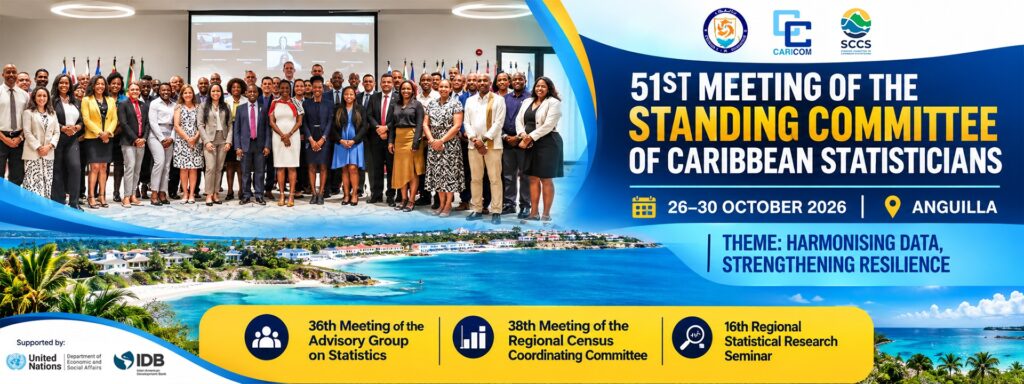
During the course of this week, we shall participate in the 51st Meeting of the Standing Committee of Caribbean Statisticians, the 38th meeting of the Regional Census Coordinating Committee, and the 16th CARICOM Regional Statistical Research Seminar. The confluence of these events is held together through our carefully selected theme, ‘Harmonising Data, Strengthening Resilience ‘, and I have no doubt you will, by the end of the week, contribute to the renewal of a resolve to build on the past and chart a common course for statistics development in our Community. You will no doubt agree that undertakings like this, which we are gathered for, is best served through strong and trusted partnerships. Allow me therefore to express my sincere appreciation to the government and people of Anguilla for graciously hosting these important regional meetings for the very first time. We are grateful for the warm hospitality extended to us and for the excellent arrangements that have been put in place to ensure the meetings proceed smoothly. Your commitment to cooperation and partnership to promote advancement in regional statistics is deeply valued, and we thank you for welcoming us to your enchanting shores.
We also wish to extend our deepest gratitude to the United Nations Department of Economic and Social Affairs (UNDESA) and the Inter-American Development Bank (IDB) for their generous contributions to support some of our member states’ participation. You have answered the call, and your partnership in development is both acknowledged and appreciated. The role that DESA and the IDB are playing at this precise juncture is of particular relevance given the urgency we face to improve the measurement of vulnerability and advance sustainable development across CARICOM’s Small Island Developing States (SIDS).
Ultimately, our collective efforts must ensure that our leaders have access to robust, reliable and comparable statistical evidence that reflects the realities, circumstances and unique vulnerabilities of our countries. Such evidence is critical not only for informing sound policy and development planning, but also for strengthening our case for access to the development financing required to address these vulnerabilities, build resilience and confront the existential threats facing our Small Island Developing States.
Our theme, ‘Harmonising Data, Strengthening Resilience’, therefore speaks directly to both the importance of the work of statisticians in implementing the Regional Strategy for the Development of Statistics and the broader development challenges facing our Caribbean Community.
Reliable, timely, comparable and disaggregated statistics are essential for sound policymaking, monitoring development progress and a clearer understanding of the vulnerabilities affecting our countries and people. Through greater harmonisation of our statistical systems, we can improve the comparability of data across countries and over time, strengthen the evidence base for national planning and regional decision-making, and present a clearer, more coherent picture of the Caribbean Community’s shared challenges, development needs, and collective progress.
Over the coming days, the meeting will review progress and priorities across the Regional Statistical Work Programme, consider the Programme of Work for 2026/2027, and explore practical opportunities for technical cooperation, knowledge exchange and South-South cooperation. The Regional Census Coordinating Committee will advance preparations for the 2030 Census Round, including consideration of the 2030 CARICOM Regional Census Strategy. The Regional Statistical Research Seminar will provide a valuable space to share research, methods and innovations that can improve the production, dissemination and use of statistics. A special feature of the 51st SCCS will be the Capacity Building Day on leveraging statistics and the ABAS to Address Multidimensional Vulnerability and Build Resilient SIDS, highlighting the role of data and partnerships in strengthening regional resilience.
Achieving these goals and ambitions depends first and foremost on the commitment and expertise of our Heads of National Statistical Offices and their staff. We recognise the demanding work you continue to undertake, often in circumstances of declining resources and increasing demands and expectations. Your dedication to producing trusted official statistics, maintaining essential statistical programmes and responding to new data needs is critical to the development of our countries and the Region as a whole.
The CARICOM Secretariat remains committed to supporting Member States and Associate Members through regional harmonisation, capacity development, statistical modernisation and the effective implementation of the Regional Strategy for the Development of Statistics. However, sustained progress requires strong national ownership, effective partnerships and sustained investment in statistical systems.
I have often argued that whilst significant, relevant and important work is being undertaken by our national statistical agencies, the spread and reach of statistics has remained too restricted. You speak amongst yourselves and share both your successes and your frustrations amongst yourselves. I hope for the day when the audience for discussions about the importance of statistics will go beyond the constricted space of statisticians and penetrate spaces, both in the public and private sectors, drawing attention to industry leaders, policy makers, researchers, investors, bankers and architects of our social agendas, be that in education, health, labour or crime and law enforcement. I therefore invite you to consider expanding your reach by attracting and embracing leaders of these sectors as active participants in co-designing a wide ecosystem for statistics-led development in all sectors of our fast-evolving Caribbean society. You are custodians of data, but it is the sectors and their leaders to which the data apply that will make the difference and deliver what the Revised Treaty of Chaguaramas demands, which is the improvement of the lives of the people of the Community.
Governments and development partners will remain central to the call for adequate resources to sustain statistical production, address existing and emerging data gaps, and strengthen the foundation for sustainable development action, but even when this is done, application of the statistics can only be possible if those with the capacity to do so, are committed to evidence-driven decision-making.
I encourage all of us to become the advocates for an expanded ecosystem for statistics in the Caribbean. Let us use this week to engage openly, share experiences, identify common solutions and agree on practical actions that can propel a shift in how statistics and statisticians are integrated into a robust and reengineered purposeful platform for policy and practice in the Caribbean Community.
