Catching the repricing wave: insights from daily online supermarket prices
Originally published by Caribbean News Global Read the original
By Chiara Osbat, Christian Höynck, Umberto Maglione and Elisabeth Wieland
- Has the latest energy shock triggered a new wave of food price increases? To find out, we’ve used innovative AI tools to track changes in price setting by supermarkets. So far, the rise in the repricing momentum has been weaker than in 2022, following Russia’s invasion of Ukraine.
When an energy price shock hits the economy, food prices are among the first to rise. That has immediate consequences for consumers. Food accounts for around 20 percent of expenditure in the euro area consumption basket used to calculate the Harmonised Index of Consumer Prices (HICP). And this share is even larger for low-income households. As such, changing food prices play a key role in influencing households’ perceptions and expectations surrounding inflation. Meanwhile, from a monetary policy perspective, it is crucial to understand the pattern of a repricing wave. Policymakers need to grasp how quickly firms adjust prices, how widespread those adjustments are and whether they might generate persistent inflationary pressures. But how can we capture repricing dynamics affecting consumers in real time when large shocks happen?
The ECB has created a tool, the Daily Price Dataset (DPD), to follow supermarket price developments as they unfold. Since 2022 the DPD has provided information about how firms reset prices and on the likelihood that inflation arising from the shock will be strong, broad-based and persistent. Our tool indicates that the ongoing resetting of food prices triggered by the energy shock arising from the war in the Middle East is weaker than that in 2022 following the Russian invasion of Ukraine. The data show that initially food repricing increased fairly broadly but then stabilised. This contrasts with what happened during the 2022 energy shock, when the repricing wave continued to rise.
How do firms react to a cost shock?
Following a cost shock, firms decide whether they will adjust their prices and by how much. They make decisions based on factors such as the size of the shock, competitors’ prices and the costs of changing prices (so-called “menu costs”). If shocks are small, firms will not deviate from their regular repricing plans, but if they are large, they will want to adjust prices earlier than planned (so-called “state-dependent pricing”). In this case, we will observe an increase in the frequency of price increases, leading to non-linear effects on the inflation response that are relevant for monetary policy.
Two aspects are especially informative. The first is how often firms raise and lower prices, known as the extensive margin. The second is the size of those price changes, known as the intensive margin. Together, these reveal the answer to the following question: is observed inflation the outcome of a few, very large price increases or of a broad-based repricing wave across products and retailers?
To address this question, ECB staff in the PRISMA research network developed the DPD, working with the BIS Innovation Hub and the Deutsche Bundesbank under Project Spectrum. The dataset uses daily online supermarket prices and an AI-based classifier that maps retailers’ product descriptions onto consumption categories underlying the HICP basket.
It measures the resulting repricing frequencies monthly to remove short-lived fluctuations, including temporary sales. However, because the tool collects underlying observations every day, it can update the estimate for the current month continuously throughout the month.
2026 versus 2022: What does the DPD tell us?
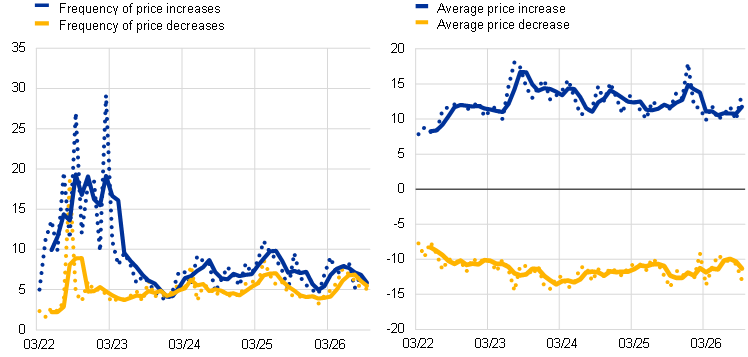
The frequency of food price increases rose in March 2026, shortly after the energy shock hit (Chart 1, panel a). However, this increase was much smaller than during the inflation surge of 2022. In contrast, the gap between the frequency of price increases and decreases is small. The average size of price increases changed relatively little, similar to the 2022 episode (Chart 1, panel b).
Chart 1 – Frequency and size of food price changes over time
Chart 2 provides a broader view by grouping food categories according to the frequency of price increases. The yellow areas show the share in the food basket of categories in which 10 percent or more of individual product prices increased in the month.
During the 2022 inflation surge, these shares expanded and remained large for several months. This indicated a broad and persistent shift towards more frequent price adjustments. Such behaviour is consistent with state-dependent price-setting by firms in the euro area during the 2021-24 inflation cycle.
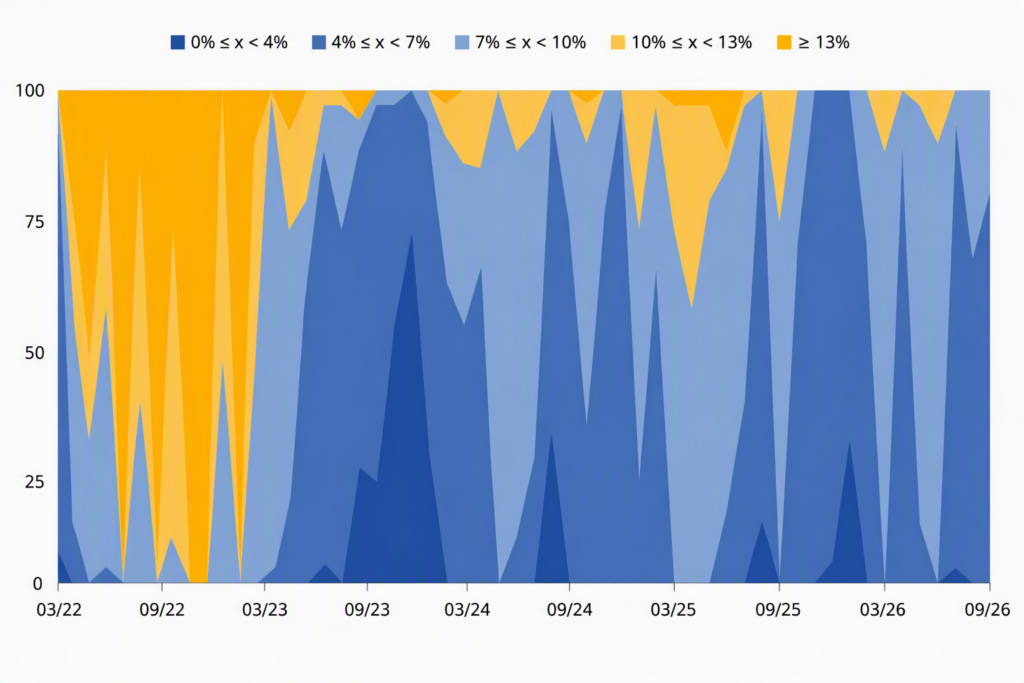
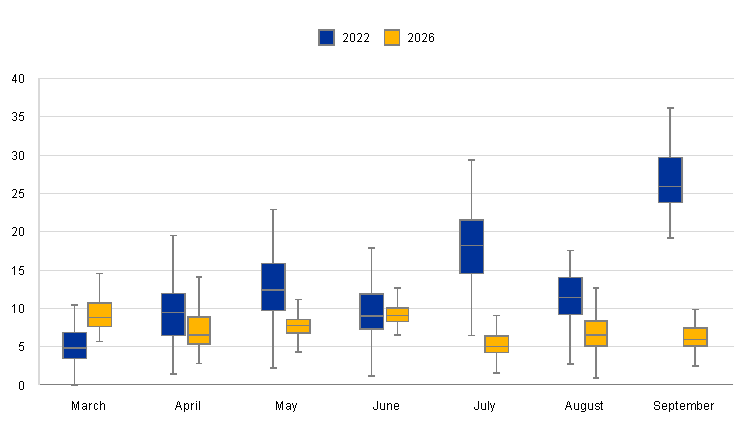
Chart 3, which shows the distribution of repricing frequencies across individual food categories, indicates that while there was an initial rise in March 2026, the frequency of price increases did not rise and widen sequentially in 2026 as it did in 2022.
The range of price changes is overall more compressed in 2026 compared with 2022, and the maximum frequency of price changes is also far lower in most months of 2026.
Conclusion
For monetary policy, after an energy shock we need to ask whether higher costs are triggering a broad and persistent repricing response and non-linear inflation dynamics. To answer that question, it is essential to establish not only that the inflation rate has increased, but also through which margins. This is because inflation can rise owing to more frequent repricing, larger individual price changes, broad-based increases or large surges in very specific products. The ECB’s DPD provides an early indication of which of these margins are driving inflation.
Following the 2026 energy shock, we find little evidence so far of a persistent change in how often retailers reprice food items, in contrast to 2022. This contrast between 2022 and 2026 is consistent with the broader finding that the effects of an energy shock depend on the composition of the shock itself as well as on the economic conditions prevailing when it occurs.
