Court of Appeal president to fill a gap
Originally published by Jamaica Observer Read the original
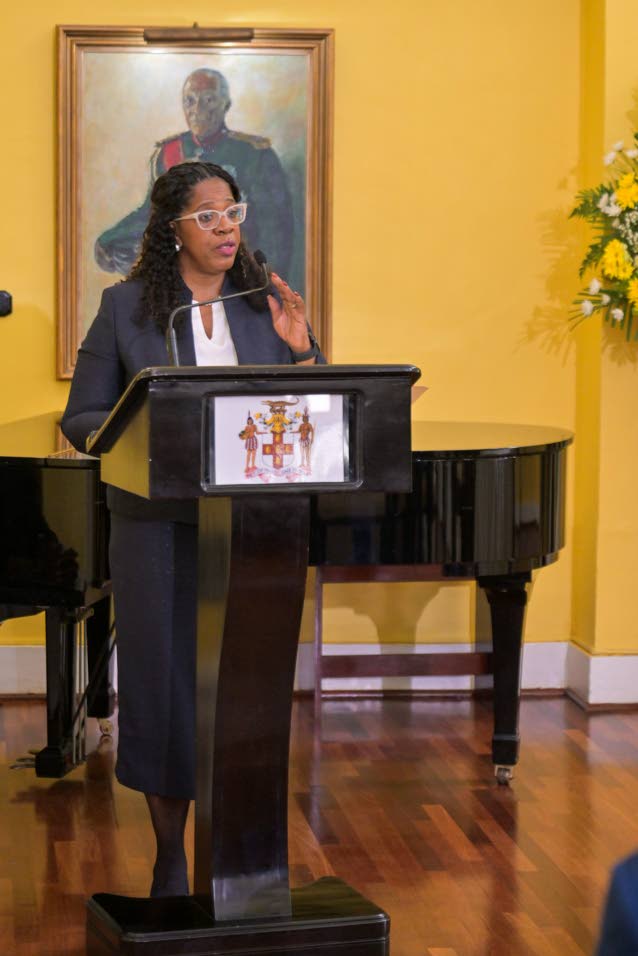
Appeal court President Justice Marva McDonald-Bishop has begun to pen a book chronicling the history of that court after an AI search bot informed her there is a “dearth” of information about the institution.
McDonald-Bishop, who took the reins of the institution in 2024, becoming the first woman ever to hold that post, says upon being appointed she decided to “understand the court” she was “called upon to lead” and, as such, began to search for historical documentation.
“I started my research by digging up the Hansard reports from Parliament and other literature, only to be told by AI that there is a ‘dearth of information’ on the Court of Appeal and that persons concentrate more on the Privy Council and other courts of the Commonwealth,” McDonald-Bishop told individuals attending a recent Judiciary Day Public Lecture at the court on King Street in downtown Kingston.
“Then AI said to me, ‘If you were to contribute to the scholarship about the Court of Appeal that would be a powerful contribution to constitutionalism in Jamaica.’ So I decided to start my book about the Court of Appeal and today is just a chapter from that book,” McDonald-Bishop, who delivered the guest lecture titled, ‘The Court of Appeal of Jamaica: Its path to institutional independence and national standing’, stated.
Noting that the court’s “institutional story is inseparable from Jamaica’s own journey into constitutional independence”, the appeal court head said to trace its development is to “trace part of Jamaica’s institutional coming of age.
The movement from inherited arrangements to a national appellate court capable of promoting coherence in Jamaican law and safeguarding justice for our people,” she said.
A brief history of the court on its website says it was established by the Constitution of Jamaica when the country gained its political independence from Britain on August 6, 1962 and, therefore, like Jamaica, celebrated its 60th anniversary on August 6, 2022. It said the court’s structure and jurisdiction were, however, crafted by a law that was passed on July 30, 1962 and brought into effect on the 5th of August that year — one day before Independence Day. The legislation regulating the court’s authority and jurisdiction is now called the Judicature (Appellate Jurisdiction) Act.
The court succeeded a previous Court of Appeal which was, however, a part of the Supreme Court of Judicature of Jamaica. The former Court of Appeal was brought into effect by the Judicature (Court of Appeal) Law, which was passed in 1935 and remained in effect, with amendments, until its repeal by the Act. Immediately before the change in 1962, an appellate tribunal was constituted by three judges of the Supreme Court sitting as a panel.
The present court has no inherent jurisdiction. It derives its authority from the Constitution of Jamaica and from its enabling legislation, which also gives it all the powers that the previous court enjoyed. It hears appeals from all divisions of the Supreme Court of Judicature of Jamaica as well as all parish courts. There is also provision for appeals directly to the court from the decisions of certain bodies, such as Courts Martial and regulatory bodies such as the General Legal Council and the Public Accountancy Board.
The court, when it was established in 1962, comprised a president and three judges of appeal. In addition, the chief justice was, and continues to be qualified, by virtue of being the head of the judiciary, to sit as a member of the court. That may only occur, however, if the chief justice is invited, by the president, to so sit, and if at least four other judges of appeal are also sitting as part of the court. That has, so far, only happened on ceremonial occasions.
In 1967, the number of judges comprising the court, not including the president, was increased to six. That complement of seven remained unchanged for over 50 years. In 2008, legislation was passed to increase to 12, the maximum number of judges of appeal, not including the president. Due to constraints of accommodation, however, the complement of seven was not increased until January 2019, when it was increased to 10, and the full complement of 13 was fulfilled for the first time on January 18, 2021.
A panel at the Court of Appeal usually consists of three judges. In exceptional cases, more judges of appeal, typically five, may sit to hear a case. Two divisions of the court usually sit to hear cases.
There have been 13 presidents of the court since 1962. The first 12 have all been males.
When the new court was constituted in 1962, it continued to be located in the same building that houses the Supreme Court and, as time progressed, occupied various areas there. In 1997, the court relocated across King Street, where it was sandwiched between the Office of the Director of Public Prosecutions and the Accountant General’s Department. In January 2019 it moved to its present location, which had been previously occupied by the Accountant General’s Department.
The entrance to the court’s registry is on Barry Street, between King Street and Peter’s Lane. The courtrooms are on the first floor and the entrance to them is on King Street.