‘DISGRACEFUL’
Originally published by Jamaica Observer Read the original
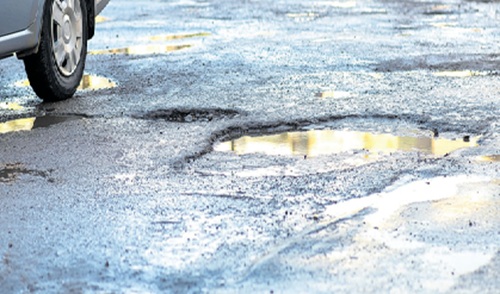
ROADS dug up by the National Water Commission (NWC) and left with massive ditches for months, and even years, took centre stage at Tuesday’s sitting of Parliament’s Public Accounts Committee (PAC), as Government and Opposition members turned their fire on the agency.
The grilling came as the NWC appeared before the PAC for a review of the Auditor General’s Performance Audit Report on its effectiveness in managing capital projects and the credibility of its budgets at the entry level.
The appearance also came as Jamaicans continue to grapple with drought conditions linked to El Niño, with the NWC expected to face questions about water resources for communities severely affected by the dry spell.
But while the committee addressed the country’s water challenges, it was the NWC’s long-standing road-reinstatement arrangement with the National Works Agency (NWA) that drew some of the sharpest criticisms, with committee Chairman Julian Robinson declaring that the system “doesn’t work” and recounting instances in which roads remained unrepaired for weeks, months and years.
At the heart of Tuesday’s road discussion was a memorandum of understanding (MOU) between the NWC and the NWA under which the works agency is responsible for repairing road dug up made by the commission, with the NWC reimbursing the agency for the work.
NWC vice-president responsible for engineering and capital projects Garth Jackson confirmed that the MOU remains in effect and said it covers roads under the NWA’s portfolio across the country.
Jackson explained that under the arrangement, the NWA carries out the road repairs while the NWC provides the funds, reimbursing the agency for the cost of repairing road cuts.
But when Robinson asked whether the NWC owed the NWA money for road reinstatement, Chief Financial Officer Fabian Christie said the commission did not currently have any outstanding debt to the works agency for that purpose.
(From left) National Water Commission Vice-President of Engineering and Capital Projects Garth Jackson; permanent secretary in the Ministry of Water, Environment and Climate Change Wayne Robertson; and NWC Chief Financial Officer Fabian Christie during Tuesday’s Public Accounts Committee sitting.
“We have some other disputes pertaining to some other projects. But not for reinstatement of roadworks,” Christie said. That answer prompted Robinson to question how the two agencies communicate when the NWC excavates a road to repair a leak or replace a pipe. Christie said there are coordinators between the agencies to deal with such matters, but Robinson rejected the explanation, saying the experience of motorists and Members of Parliament suggested otherwise. “It doesn’t work… let’s just be plain. It doesn’t work, and…I understand reinstatement can’t take place the following day because you want to ensure the thing is fixed properly before you reinstate. But I can tell you about weeks, months, and years where there is no reinstatement. “So I don’t know that protocol. You tell me about communication…I don’t know where that exists, and the MP is the one who gets the cussing and the MP then has to call somebody at Water Commission or NWA to say, ‘Listen, this part of Anderson Road, which I paved like a carpet, you dig it up a year ago and it’s still not fixed’. So there is no protocol there,” lamented Robinson. The exchange led permanent secretary in the Ministry of Water, Environment and Climate Change Wayne Robertson to acknowledge that the agreement needs to be reviewed. The committee also heard that the problem may stem from the difficulty of mobilising equipment and asphalt for small sections of road. Member of Parliament for St James Central, the Government’s Heroy Clarke, said he had been told by NWA officials and contractors that small road cuts are sometimes allowed to accumulate before repairs are carried out. “They give you this argument, and I want NWC to verify… that they are unable to do one square metre each time. So they allow it to pile up to a certain amount, and that’s where the six months and the one year come in. Because, for example, if they only have one leak in Montego Bay, and it is just one square metre, then they’re not going to fix it until they get some more, which may never happen,” Clarke said. Clarke also questioned who checks the quality of work carried out by contractors after the NWA is engaged to repair NWC road cuts. He pointed to Salt Spring in St James, where he said the Government had spent $237 million on a pipeline from Quarry to Meggie Top, only for sections of the rehabilitated road to develop potholes after rainfall. The NWC told the committee that responsibility for road reinstatement varies depending on the type of work being done. “We handle roadway reinstatement on a number of different bases. So, for our capital projects, where we have third-party contractors, they are responsible for doing the roadway reinstatement, and that we incorporate the road authority [NWA] to ensure, one, that the compaction is to their satisfaction, and two, that the roadway reinstatement meets their requirements at the end,” he said. For routine road cuts, Jackson said the NWC sometimes engages contractors directly, particularly in emergency situations, although the commission prefers to use the NWA arrangement. He explained that the entity relies on the NWA because of its expertise in road work. Opposition spokesman on land and works Lothan Cousins, contributing to the discussion, questioned whether the arrangement was working equally well outside the Corporate Area. He said rural MPs often had difficulty getting information about when road cuts would be repaired and suggested that Kingston received more attention under the MOU. Cousins also asked for a system that would allow MPs and other officials to track road cuts from the time they are made until they are permanently repaired. His concern was that limited NWA resources could leave roads patched temporarily while communities waited for proper reinstatement. Cousins also raised concerns about sections of Retreat Avenue, Seymour Avenue and Wellington Drive in St Andrew, where he said repeated patching and rehabilitation had failed to stop significant settlement and deterioration. He described the situation on Retreat Avenue as a “disaster” and questioned the NWC about the contractors involved, the amount spent and whether the commission or contractors were paying for repeated rehabilitation. “When you drive on these roads, they are worse than they were before you started to cut them, and these are roads that were completely rehabilitated, but now it is a disaster. So, who is the contractor? How much money was spent on these roads? And in reality, is it that the NWC is paying for these continuous rehabilitations or is this at the expense of the contractor? “Because it goes back to this audit report in terms of proper planning, accountability, these are serious issues and nobody can deny them. They are there before the eye, especially on Retreat avenue, and it is disgraceful, I can tell you that much,” said Cousins. Jackson attributed some of the problems to the difficult conditions under which the NWC is installing new water and sewer infrastructure. “The challenge that that particular project raises, there are a myriad of challenges it’s experiencing. We’re…in the process of installing large diameter sewers, large diameter potable water pipe, distribution pipes, property laterals for the water and waste water. “And we are doing that where there is an existing aged infrastructure. The problems we have encountered there are in terms of subsidence, settlement subsidence is largely as a result of the breaks on the old pipes, the existing pipes. So that is what happened on Retreat, a few weeks ago,” Jackson said. As the committee pressed the NWC on its road-reinstatement arrangements, Christie disclosed that the commission spends approximately $200 million annually on reinstating roads through contractors it engages directly. The committee did not complete its examination of the report and Robinson instructed NWC officials to prepare responses to outstanding questions for a future sitting. Among the unanswered questions was how much the NWC owes contractors overall, separate from its road-reinstatement payments to the NWA. Christie said that figure would have to be broken down before being provided to the committee.