Dr Bernadette Bryan-Frankson’s journey from a classroom discovery to global recognition
Originally published by Jamaica Observer Read the original
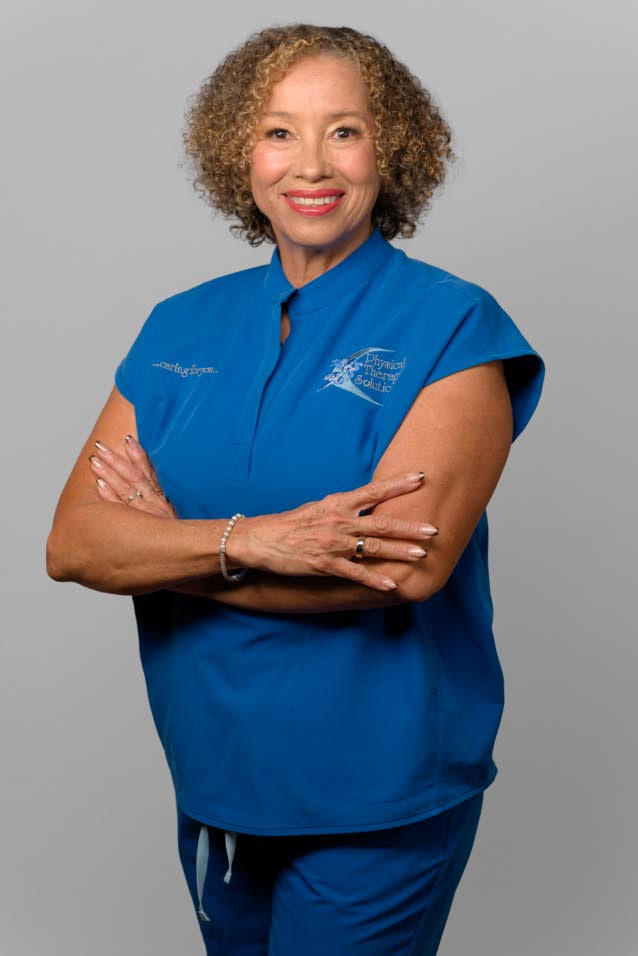
IT was a Monday morning at Alpha Academy when a teenage Bernadette Bryan-Frankson opened a Sunday magazine brought to school by one of her classmates. Inside was an interview with Elizabeth Murray, a British physiotherapist who had moved to Jamaica. Something clicked.
“I read that article, and it was as though a light bulb came on,” Bryan-Frankson recalls.
There was another connection, too. Her father had suffered a stroke, and she remembered someone at the hospital instructing him to do exercises. Until that moment, she had never fully understood who that person was, or the role rehabilitation could play in recovery.
Suddenly, it made sense.
“I must have read that article a thousand times. I knew almost immediately that physiotherapy was the profession for me.”
More than four decades after entering the School of Physiotherapy in Kingston in 1978, Dr Bernadette Bryan-Frankson, PT, DPT, MBA, CLT, CCRT, has come full circle in a way that the sixth-form student reading that magazine could scarcely have imagined.
The Jamaican physiotherapist, educator, entrepreneur and clinical leader has been selected for recognition among World Physiotherapy’s 75 Noteworthy Physiotherapists, part of the global organisation’s 75th anniversary celebrations.
For a woman whose career has been built around movement, reinvention and an almost relentless curiosity about what might come next, the recognition has given her a rare opportunity to stop briefly and look back.
“My immediate reaction was one of surprise and absolute elation,” she says. “I knew I was nominated, but I certainly did not expect it.”
Then came humility.
Among the practitioners recognised were people such as Robin McKenzie and Kari Bø, whose work had influenced Bryan-Frankson’s own professional development in orthopaedics and pelvic health.
“To find my name included in a group with people whose work helped shape how I practice was quite overwhelming,” she admits.
After the excitement came reflection: the patients, students, colleagues, mentors and team members; the ideas that became services; and the many occasions on which she simply continued doing the work without considering where it might eventually lead.
“For me, this is the pinnacle of my professional recognition,” she says. “It comes from the global body representing our profession and reflects an entire career of contribution.”
A career she never planned
Interestingly, the career Bryan-Frankson has built bears little resemblance to the one she imagined when she first entered physiotherapy.
Athletic and young, she thought sports physiotherapy would be her future. Cardiac rehabilitation also fascinated her.
Instead, her curiosity led her through orthopaedics and musculoskeletal rehabilitation, postgraduate education, professional leadership, entrepreneurship and eventually into specialist fields including pelvic health, lymphoedema, aquatic rehabilitation and canine rehabilitation.
“The reality has been far broader than the career I imagined as a young physiotherapy student,” she says.
What remained constant was her desire to learn.
Her professional philosophy has increasingly been shaped by identifying the places where services are limited and asking what physiotherapy might be able to contribute.
That mindset has made Bryan-Frankson something of a builder.
“I think what gives me the greatest pride is not one qualification or one position,” she explains. “It is seeing ideas become services, and then seeing those services improve lives and create opportunities for others.”
She points to helping develop specialist rehabilitation services in pelvic health and lymphoedema, mentoring younger professionals and building Physical Therapy Solutions Ltd into a comprehensive private practice.
And, at a stage in life when many people might reasonably begin thinking about slowing down, Bryan-Frankson decided to learn something entirely new.
Canine rehabilitation
Her own experiences with injured dogs made her aware of a significant gap in Jamaica. Curiosity led to research; research led to formal training; and eventually, the idea became Paws for Physio, Jamaica’s first canine rehabilitation unit.
“I have never been very comfortable with the idea that because something is unfamiliar, it should remain unexplored,” she says.
Her formula is deceptively simple: curiosity first, preparation second and courage after that.
“You do not need to know everything at the beginning. You need enough humility to recognize what you do not know, enough discipline to learn properly, and enough courage to begin once you are prepared.”
That willingness to build where she is rather than waiting for ideal circumstances has become central to Bryan-Frankson’s professional identity.
“I chose to make my professional life in Jamaica,” she says. And she is proud of that decision.
She speaks candidly about operating in a region that does not always enjoy the resources, visibility or scale of larger countries. But she rejects the idea that geography should determine ambition.
“Excellence does not require a large stage in order to matter.”
Physical Therapy Solutions physio colleagues, from left: Dr Satish Gollamudi, Jordanne Ifill, Dr Bernadette Bryan-Frankson, Nina McDonald, and Gayean Johnson.
For Bryan-Frankson, her global recognition therefore carries meaning beyond the individual accolade. She wants younger Jamaican and Caribbean practitioners to see what it represents. “Where you begin does not determine how far your contribution can reach,” she says. “Our region has knowledge, creativity and leadership to offer the global profession.” It is also a message she has lived through entrepreneurship. When she established Physical Therapy Solutions, Bryan-Frankson wanted more than a treatment facility. She wanted to demonstrate what a Jamaican-owned private physiotherapy practice could become: clinically excellent, professionally managed, compassionate, progressive and focused on the entire patient experience. Entrepreneurship, she says, eventually forced her to think much further beyond the clinician-patient relationship. “As a clinician, you are trained to assess, reason, treat and respond to the person in front of you. As an entrepreneur, you have to think about people, systems, finance, operations, culture, leadership, risk and sustainability, all at the same time.” It also taught her resilience. That resilience was tested profoundly during the COVID-19 pandemic. Rather than focus solely on survival, Bryan-Frankson made a conscious decision to use the period to strengthen systems, improve operations, develop leadership within her organisation and, importantly, retain employees. “Leadership becomes most visible when circumstances are uncertain,” she reflects. “It is relatively easy to lead when things are going well; the real test is whether you can remain calm, make difficult decisions, protect people where possible and still keep looking ahead.” More than movement Ask Bryan-Frankson what physiotherapy has taught her after more than four decades, and her answer reaches far beyond muscles and joints. “Movement is about far more than the body; it is about restoring confidence, independence and possibility.” She has witnessed that possibility repeatedly. Among the experiences that remain especially meaningful are her encounters with patients living with severe lower-extremity lymphoedema and elephantiasis. Many arrive not expecting significant improvement. When treatment reduces the swelling, she says, the transformation extends beyond the physical. “It’s not just about the reduction in the size of the legs. It’s their potential to now have a normal life.” Those moments remind her that rehabilitation is ultimately about returning people to their lives—to roles, activities, relationships and parts of themselves that illness or injury may have taken away. And the principle applies to mentorship as much as patient care. “When I see someone I have taught or mentored go on to help others, the impact extends even further.” What else is possible? There is something almost contradictory about receiving what she describes as the pinnacle of her professional recognition while simultaneously insisting that she is nowhere near finished. Yet that may be the clearest explanation of Bernadette Bryan-Frankson. The accolade has not made her want to stop. It has energised her. She is interested in expanding virtual rehabilitation to reduce geographical barriers to specialist care across Jamaica and the Caribbean, developing services in areas such as postpartum pelvic health, extending virtual canine rehabilitation, and creating more structured ways to pass decades of knowledge to another generation through mentorship, digital programmes, education and writing. Retirement, it seems, remains a distant thought. She laughs at the idea of winding down when there are still gaps to identify, services to build and people to develop. Even her advice to women pursuing careers in healthcare, leadership and entrepreneurship carries that same restlessness. Believe in the value of your vision, she says. Don’t wait until you feel completely ready. Learn what you need to learn and begin. Remain teachable. Take calculated risks. Build strong teams. And when you succeed, hold the door open for the women coming behind you. If she could speak to the young Bernadette sitting in that Alpha Academy classroom in 1978, she knows exactly what she would tell her. Trust the light bulb. Don’t be afraid when the path changes. Remain curious. And understand that she does not have to leave Jamaica to dream big. “I would tell her that the dream will keep changing, and that is perfectly all right.” Then comes the question that perhaps best captures both her career and the woman behind it: “What else is possible?” At 45-plus years and counting, Bernadette Bryan-Frankson is still determined to find out.