Five key takeaways from The Cost of Silence: What the UK’s visa move means for St Lucia’s trade in services, and why a response is urgent
Originally published by Caribbean News Global Read the original

– Dr Claudius Preville’s book argues “A country that does not stand up for its exporters is a country that exporters trust less.”
By Caribbean News Global
CASTRIES, St Lucia – In March 2026, the United Kingdom imposed a visa requirement on all Saint Lucian passport holders. The decision came just one month after British and Saint Lucian officials discussed expanding services trade under the UK-CARIFORUM Economic Partnership Agreement.
Known as the “Helen of the West,” Saint Lucia was fiercely contested, changing hands 14 times between the French and the British before finally being ceded to Britain under the 1814 Treaty of Paris at the close of the Napoleonic Wars. On 22 February 1979, Saint Lucia achieved full independence as a sovereign nation within the Commonwealth.
“The book has also been honest about the risks. A reciprocal visa could deter UK visitors, invite diplomatic pushback, and leave Saint Lucia isolated if regional partners do not follow. Those risks are real, and they were treated seriously in Chapter 4: When the Response Falters. But the existence of risk is not an argument for paralysis. It is an argument for preparation. The question is not whether a response carries costs; the question is whether those costs are smaller than the costs of continued silence. On the evidence assembled here, they are.”
In the pages of the book, you will find that “it is written for anyone who cares about the country’s economic future,” writes Dr Preville, “but it is addressed especially to the people who make policy and to the business leaders who live with the consequences of it. If it succeeds, it will have made the case that the visa is not a minor inconvenience. It is a trade barrier, and it deserves a response.”
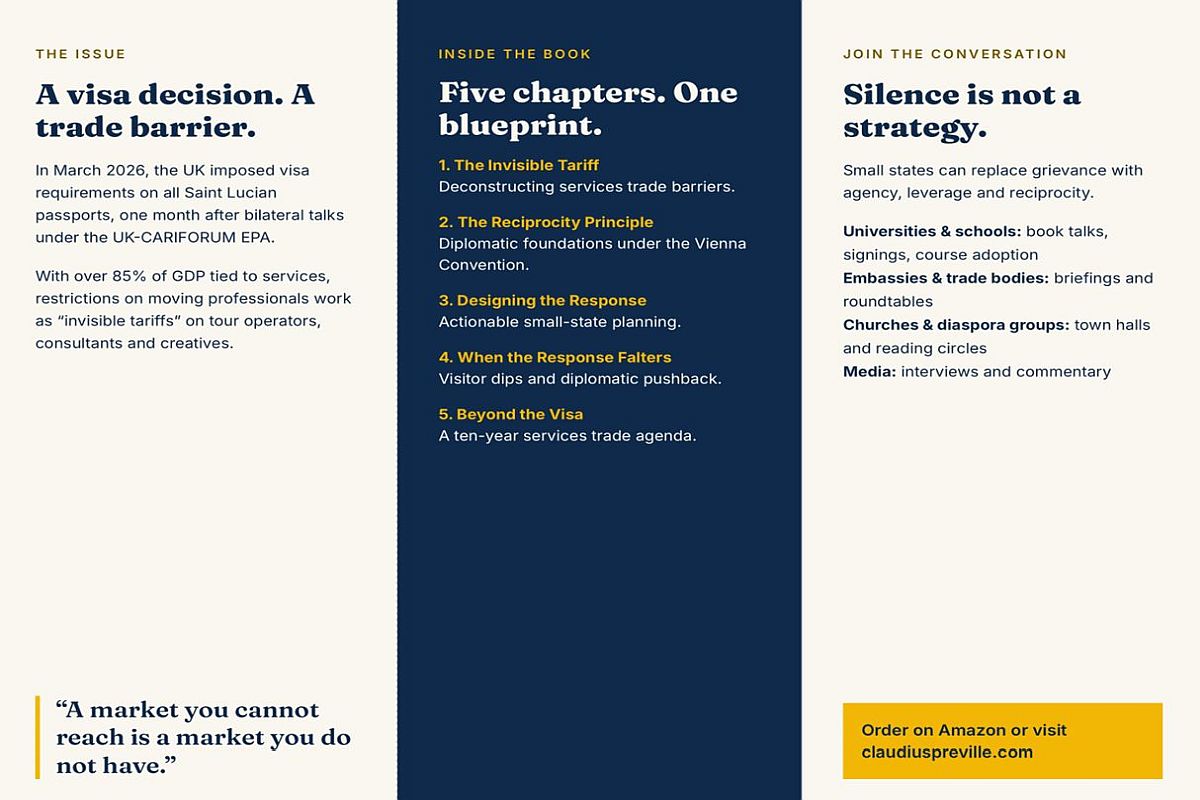
The Cost of Silence: What the UK’s visa move means for St Lucia’s trade in services, and why a response is urgent examines what this means for an economy that is more than 85 percent services — and why a structured response is urgent. Here are five central takeaways.
- Visas function as invisible tariffs: In a goods-based economy, tariffs are visible and negotiable. In a services-based economy, the ability of people to move is the equivalent of market access. Restricting that movement raises costs, shrinks opportunity, and quietly closes markets.
-
- “A market you cannot reach is a market you do not have.”
- Silence is not neutral — it is a policy choice: Every year that passes without a clear, structured response establishes a precedent: that Saint Lucia’s market access can be restricted without meaningful consequence. Silence does not preserve options; it gradually erodes them. It also signals to citizens that their ability to trade is secondary.
- Reciprocity is the minimum condition of fairness:
Small states cannot force larger partners to change policy by appealing to goodwill alone. They can, however, raise the cost of unilateral action. Reciprocity — matching access with access, and restriction with restriction where necessary — is not aggression. It is the basic logic of trade relationships.
-
- “A country that does not defend its people’s right to trade is a country that tells its citizens their work does not matter.”
- The response must be strategic, not purely reactive:
The visa issue should not become the entire conversation. It should sit inside a broader services trade strategy that includes institutional capacity, regional coordination, clearer national priorities, and a longer time horizon. The goal is not simply to reverse one decision; it is to build a posture that makes future unilateral measures more difficult and more costly. - The greater long-term risk is the erosion of confidence: There are short-term risks in speaking up — possible friction in tourism or diplomatic relations. The greater risk is the slow normalisation of diminished access and the quiet message it sends: that Saint Lucia’s services exporters and professionals can be shut out without consequence.
~ Dr Claudius Preville’s book is available on Amazon.
CNG’s related links:
