Grenada raises concern over Cuba situation at UN General Assembly
Originally published by Jamaica Observer Read the original
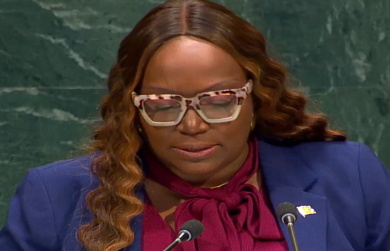
UNITED NATIONS (CMC) — Grenada has expressed “deep concern” over the continuing hardships faced by the people of Cuba, citing economic pressures and ongoing challenges affecting the country.
Addressing the 81st session of the United Nations General Assembly (UNGA), chair of the Grenada delegation Ingrid Jackson said the international community must remain attentive to the struggles of ordinary Cuban households, particularly children, the elderly and other vulnerable groups.
“We call for constructive engagement that places the well-being of the Cuban people at its centre and opens a path to meaningful relief, improved living conditions and renewed opportunities,” Jackson said.
She said Cuba and the United States must confront the difficult but solvable issues surrounding sanctions, the removal of the embargo and the need for reforms aimed at ensuring the continued welfare of the Cuban population. She noted that some reforms were already underway in Cuba.
During her address, Jackson also highlighted Grenada’s support for reform of the multilateral system, saying global institutions must better reflect the diversity, experience and aspirations of the people they serve.
Grenada joined other Caribbean Community (Caricom) member states in supporting the candidacy of Guyana’s Ambassador Carolyn Rodrigues-Birkett for the position of Secretary-General of the United Nations.
Jackson said Caricom leaders had endorsed Rodrigues-Birkett as the region’s candidate, pointing to her experience as Guyana’s former foreign minister and permanent representative to the United Nations as evidence of her commitment to diplomacy, dialogue and international cooperation.
She said the Caribbean has demonstrated that the size of a country does not determine the strength of its ideas, leadership or contributions to the international community.
Jackson described Rodrigues-Birkett’s potential election as a historic moment for the Caribbean and an affirmation that small island developing states can contribute to leadership at the highest levels of the multilateral system.
Jackson said Grenada also supports Caricom’s call for the timely renewal of the mandate of the Gang Suppression Force (GSF), along with its rapid deployment in partnership with the Haitian National Police.
She stressed the need for adequate personnel, financing, equipment and logistical support, while ensuring appropriate human rights safeguards.
According to Jackson, strengthening security in Haiti is essential to creating the conditions for credible, free, fair and inclusive Haitian-led elections, stronger national institutions and the restoration of constitutional governance.
“Haiti is not a failed state. Haiti represents a promise yet to be fulfilled. It is a promise to the Haitian people that the international community must honour not with pity, but with purpose, not temporarily, but sustainably,” she said. “And even as we respond to the security crisis, humanitarian assistance must remain at the centre of our efforts.”
Jackson said the UN General Assembly is taking place at a time of major global transformation, presenting both challenges and opportunities to strengthen international cooperation.
Referencing the UNGA theme, “Restoring Trust, Managing Transformation, a United Nations that delivers for all”, she said countries must move beyond declarations and focus on delivering practical results.
For Grenada, she said rebuilding trust requires demonstrating that international cooperation produces meaningful outcomes, respecting the voices of small states and creating genuine partnerships that allow all countries to pursue their development goals.
Jackson reaffirmed Grenada’s commitment to the principles of the United Nations Charter, international law, peaceful dialogue and the peaceful settlement of disputes.
“In an increasingly interconnected world, cooperation is not merely desirable; it is indispensable,” she said, adding that “the transformation we advocate internationally must also take place at home”.
Jackson said Grenada is pursuing a long-term development roadmap ahead of its 75th anniversary of independence, with transformation centred on people and resilience.
She said this includes strengthening the economy while protecting the environment, embracing technology while safeguarding humanity and preparing for climate-related challenges before disasters occur.
“As a small island developing state, Grenada understands resilience but experience has also taught us that resilience cannot begin after disaster strikes,” she said.
Jackson called for greater international cooperation on climate adaptation, disaster preparedness, resilient infrastructure and access to financing.
She said small island developing states should not be viewed only as victims of climate change, but also as examples of resilience and innovation.
“Climate action remains one of the areas in which collective effort can make a profound difference. Grenada remains committed to strengthening resilience and advancing sustainable and low carbon development but ambition without implementation is merely aspiration,” Jackson warned.
She urged greater access to predictable and responsive climate financing, saying vulnerable countries need the resources required to implement their commitments.
Jackson welcomed international efforts to recognise that development challenges cannot be measured by income alone.
She said the multidimensional vulnerability index provides an opportunity to better account for the unique circumstances of small island developing states, including exposure to climate change, natural disasters and external economic shocks.
Grenada, she said, encourages member states, development partners and financial institutions to adopt vulnerability-informed approaches to development financing.
She added that improved access to concessional financing, climate finance, disaster risk financing and innovative financial tools can help countries transition from vulnerability to resilience and from recovery toward sustainable growth.