Jamaica is turning a ship in a sports car world
Originally published by Jamaica Observer Read the original
AFTER more than 20 years in politics, building a global business has given me a different vantage point on something I spent years debating in Parliament: How value is created, moved and captured.
I now sit inside a global value chain, sourcing across borders; manufacturing in Italy; moving inventory into different markets; navigating freight, duties and regulation; negotiating distribution; managing margins and cash flow; and understanding what makes a customer discover you, trust you, buy from you, and come back.
Seeing that machinery from the inside has sharpened something I believed long before I entered business: Jamaica has to think globally and act locally. In politics an announcement can become an event. In business, nobody particularly cares what you intend to do. Execution is the event.
From the beginning I made a deliberate decision: Although its founder and CEO is Jamaican, my skincare would be formulated and made in Italy where I could access the science, formulation expertise, clinical testing, and manufacturing standards necessary to compete globally and build for scale. It was strategy, not sentiment. Outside Jamaica, nobody particularly cares who you are in Jamaica. The world doesn’t owe you shelf space. You have to compete.
Therefore, I positioned the company inside the markets where I intended to compete, including launching in New York. And the questions I spent years in Parliament asking about Jamaica became even more urgent: What do we make? What do we own? What can we sell to the world? Who controls the distribution? After everyone along the value chain has been paid, how much of the value created actually comes home to Jamaica?
What has changed is my vantage point. I’m no longer examining those questions only through the lens of public policy; I’m experiencing them from inside a business competing in the global economy.
Jamaica has done difficult and necessary work to stabilise its economy. We have substantially reduced our debt, unemployment has fallen to historic lows, and our macroeconomic credibility is stronger. We should take the win. But stability is the foundation on which you build the house. Eventually, you have to build the house.
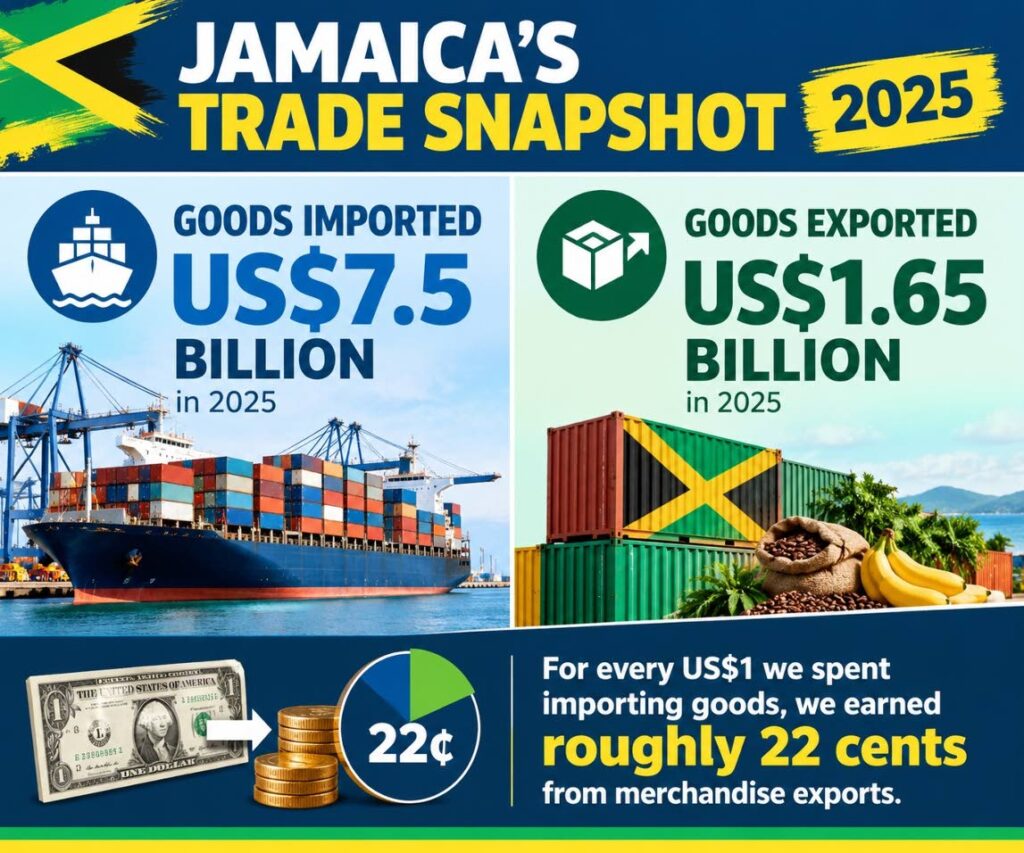
In 2025 Jamaica imported approximately US$7.5 billion in goods and exported US$1.65 billion. For every US dollar we spent importing goods we earned roughly 22 cents from merchandise exports. We’re a services economy and tourism matters enormously, but we still buy far more from the world than the world buys from us.
So the question isn’t simply whether Jamaica is growing. What are we going to build that the world wants to buy, and who is going to own it?
For years we’ve rightly concentrated on employment. A job can change the trajectory of a family but employment cannot be the ceiling of our economic ambition. Micro, small and medium-size businesses account for more than 80 per cent of Jamaican employment, yet contribute less than 30 per cent of gross domestic product (GDP). Jamaicans don’t lack entrepreneurial instinct. We lack scale.
I want more working-class Jamaicans moving into the middle class, and more middle-class Jamaicans becoming owners of capital, building businesses that export, owning intellectual property and attracting investment. That’s when the wealth equation begins to change.
Building in beauty has shown me how quickly opportunity can shift. A young, independent brand cannot outspend legacy companies, so I studied where the customer was going. The customer was moving to the phone. Discovery was moving to social media, and e-commerce was changing distribution. I believed direct-to-consumer commerce would allow smaller, more agile brands to compete differently. So I timed my entry.
US beauty sales on TikTok Shop reached approximately US$980 million in the second quarter of this year, up 82 per cent in 12 months, while skincare sales over the year to June grew 123 per cent. The larger lesson is that when technology changes the architecture of an industry, it can change the hierarchy too. Smaller companies may not have the capital or distribution of multinationals but they can have speed. Yet speed without data is simply movement. The advantage is learning and adjusting faster than your competitor.
JAMAICA HAS TO LEARN TO TURN
Changing policy and bureaucracy in Jamaica can feel like trying to turn a ship. By the time we’ve agreed it needs to turn, commissioned the study, convened the stakeholders, and begun implementing the recommendations, the world we were preparing for may already have changed.
The world isn’t moving like a ship anymore. It’s moving like a sports car taking sharp corners at extraordinary speed. AI is rewriting how we work, technology is collapsing old barriers to entry, and consumer behaviour can shift almost overnight.
You don’t survive that road simply by accelerating. You survive by being able to turn.
That requires institutional agility. How quickly can Jamaica recognise change and adjust a curriculum, regulation, incentive or investment priority?
Yes, speed without direction is dangerous but direction without speed can make you irrelevant.
Our size should be an advantage. With fewer than three million people, Jamaica should be able to coordinate, experiment and adjust faster than countries many times our size. Our size doesn’t have to be our sentence. Of course we should ask which jobs AI may displace, but if the conversation ends there we’re already behind. We should also ask what Jamaicans can build with it.
That means making choices about where we intend to compete. I would start with three: agro-processing and nutraceuticals, creative industries, and high-value tourism intellectual property. Jamaica already possesses advantages in each; the challenge is converting them into globally competitive, Jamaican-owned companies controlling more of the value chain. Debate the choices, but choose. Then align education, incentives, regulation, capital, and export support behind them.
We also have to stop confusing entrepreneurship activity with entrepreneurship outcomes. Another seminar isn’t an economic strategy. If a Jamaican company has demonstrated demand, help it scale with growth capital, regulatory expertise, intellectual property protection, export financing and distribution. Don’t tell me how many entrepreneurs attended the programme. Tell me how much they exported.
Education must follow the same logic. Technical schools designed for yesterday’s economy won’t prepare children for tomorrow’s. Robotics, coding and digital commerce must be linked to the industries we intend to build. Then measure what works: jobs created, wages earned, businesses surviving, exports generated, and foreign exchange brought home. Measure, learn, adjust and go again.
Business forces that discipline because eventually the numbers answer you. You can love your strategy but the customer doesn’t have to — so you must adjust or you will lose.
I spent 20 years believing one of the principal ways to transform a country was through public policy. I still believe that. But countries are changed by builders too — the scientist who patents something, the woman who risks her savings on an idea, the young Jamaican who creates 10 jobs instead of waiting for one.
Politics taught me how power works. Business is teaching me how value is created. Jamaica’s next economic leap requires both: public policy that understands value creation and entrepreneurs capable of converting opportunity into ownership.
We’ve stabilised the platform, now we have to build on it — more Jamaican companies, exports, productivity, higher incomes and ownership. Not simply Jamaicans participating in the global economy, but Jamaicans owning a piece of it.
Five months after launching Lisa Hanna Beauty™, we’re selling out, entering new markets, and growing our customer base globally. We’re already distributed across North America, will launch in the Caribbean in November, and are preparing for European distribution in the first quarter of 2027. And perhaps the number that matters most to me: 40 per cent of our customers globally are coming back.
There’s still much to build, but these five months have reinforced something I’ve long believed: Being small doesn’t prevent you from competing globally. Moving too slowly, thinking too narrowly, and failing to position yourself where value is being created will.
That is true for a company. It is also true for a country.
Not bad for a Jamaican girl some people think just poses in swimsuits online.
Lisa Hanna is a former Member of Parliament, People’s National Party spokesperson on foreign affairs and foreign trade, former Cabinet member and Founder and CEO of Lisa Hanna Beauty™️.