Jamaica’s slavery petition packed with years of research
Originally published by Jamaica Observer Read the original
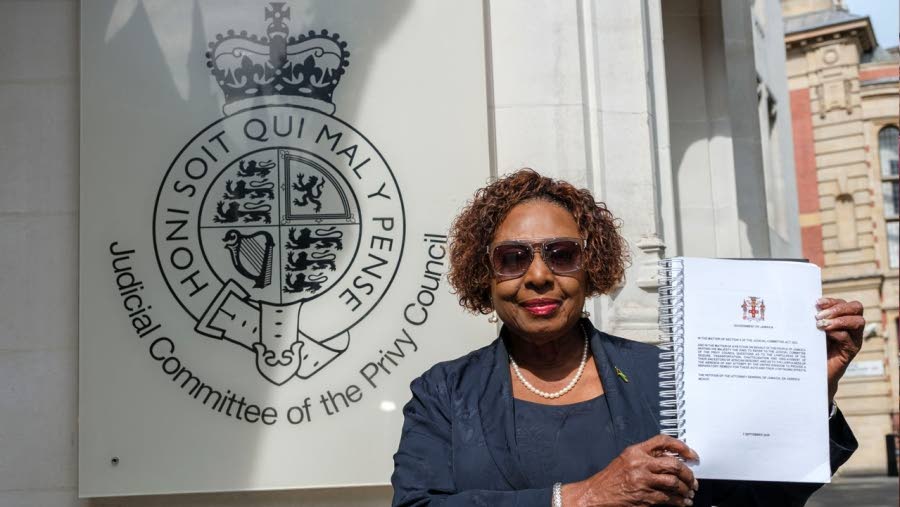
Jamaica’s petition inviting King Charles III to refer to the Judicial Committee of the Privy Council questions regarding Britain’s seizure, transportation, chattelisation, and enslavement of the island’s ancestors from the mid-17th century to 1834 is packed with heavy and emotive information gathered through extensive research conducted over at least 17 years.
“It is estimated that over a period of more than 300 years, at least 15.4 million Africans were forcibly captured and transported across the Atlantic. It is recorded that approximately 1.2 million people were transported to Jamaica alone,” the petition states in the opening section outlining the background to the application.
Filed on September 7, 2026 by a delegation headed by Culture Minister Olivia Grange, the petition gives overwhelming information about the cruelty and inhumane treatment meted out to captured Africans who were sold into slavery.
“The staggering numbers of those who arrived in Jamaica, chilling in themselves, obscure the additional detail of the significant numbers of Africans who were killed, in particular on the infamous ‘Middle Passage’. Mortality rates on the ‘slavers’, that is the ships that transported the enslaved, were extremely high in the early years of the trade in enslaved persons. By way of example, on arrival in Jamaica in 1732, the Saint Michel recorded a shocking mortality rate of 96.5 per cent,” the petition states.
“The depravity of the mercantile enterprise that systematically transformed humans into commodities was laid bare in a 1783 case about another slaver, the Zong (Gregson v Gilbert 99 ER 629). Serious navigational errors caused the voyage of the ship to become protracted, and to imperil all onboard. A number of the 442 enslaved Africans who started the journey died en route.
“The poor physical condition of those still alive as the vessel neared Jamaica meant that as ‘perishable goods’, they would have little resale value on arrival. A deliberate decision was made by those in charge of the ship to drown some 134 captive Africans in three batches. The ship’s owners argued, in order to make good a claim for insurance, that this calculated decision was not murder. Rather, the argument went, it was merely the preservation of healthy ‘cargo’ by removing the contaminants; by disposing of the frail and the infirm. There was, according to the case report in Gregson, only ‘the throwing overboard of goods, and of part to save the residue’,” the petition states.
It points out that the story of the Zong “stands figuratively for the horror of the whole slavery era”, as only 208 of the original 442 captive Africans on the Zong — a 53 per cent mortality rate — made it to Jamaica.
“Many were flung overboard still handcuffed, with some opting to jump rather than be pushed to their deaths,” the petition points out, adding that those who died are commemorated by the Zong Monument in Black River, St Elizabeth, and the episode is remembered by Jamaicans, and those of Caribbean ancestry all over the world “as evidence of Imperial Britain’s disregard for the very humanity of captive Africans, the forebears of Jamaicans of African descent”.
In the application, Jamaica is contending that transatlantic chattel slavery dehumanised people of African descent and its impact is not limited by national boundaries.
“It has caused and contributed to the enduring perception of those of African descent as inferior and has helped to entrench corrosive notions of racial hierarchy. Its dependence upon extreme violence, in order to subjugate, is reflected in the excessive use of force against black people in many countries with significant African and Caribbean diasporic communities. Unsurprisingly, in both the United Kingdom and the USA, there is a disproportionate use both of force and of incarceration, against people of African descent,” the petition states.
It gives as an example, ‘The Lammy Review’, published in 2017 and authored by former British Deputy Prime Minister David Lammy, which found that people of African descent accounted for 12 per cent of the adult prison population, and over 40 per cent of those in youth custody, despite representing just three per cent of the general population.
The review — an independent study examining the treatment of and outcomes for black, Asian, and minority ethnic people in England and Wales’ criminal justice system — noted that “these statistics reflect a level of disproportionality greater than that recorded in the United States at the time”.
Essentially, Jamaica wants the Privy Council to:
* make a determination as to “whether transatlantic chattel slavery, as practised in Jamaica, was in fact ever lawful under English law, or whether it was offensive to the fundamental principles of the common law and to certain express statutory provisions of the Westminster Parliament”;
* determine “whether the said forced transportation and chattel enslavement was a breach of relevant international obligations”, which include “those arising out of general principles of law, the peremptory prohibitions of slavery, torture, racial discrimination and crimes against humanity and obligations derived from other sources of international law”; and
* determine “whether there is a legal obligation on the part of the United Kingdom to provide a reparatory remedy to the people of Jamaica, as descendants of those subject to these dehumanising practices, and as a community of persons on whom the practices have had indelible, and continuing, negative effect”.
The petition notes that Jamaica is prevented from commencing inter-state litigation against the United Kingdom before the International Court of Justice (ICJ) under Article 36(2) of the ICJ Statute in relation to the harms resulting from transatlantic chattel slavery.
“This is because of the United Kingdom’s reservation, under Article 36(2), which states that the United Kingdom does not accept the compulsory jurisdiction of the ICJ in respect of disputes ‘with the government of any other country which is or has been a member of the Commonwealth’,” the petition states.