More rate hikes possible, economist warns after BOJ move
Originally published by Jamaica Observer Read the original
ECONOMIST Keenan Falconer expects the Bank of Jamaica (BOJ) could raise interest rates again if inflation remains high, describing Monday’s half-point increase as more aggressive than he had anticipated.
“I think the BOJ’s decision to raise rates was inevitable, albeit more aggressive than I initially anticipated. Given the extent of acceleration in inflation over the last two months, I’m not surprised it has taken this proactive stance,” Falconer told the Jamaica Observer.
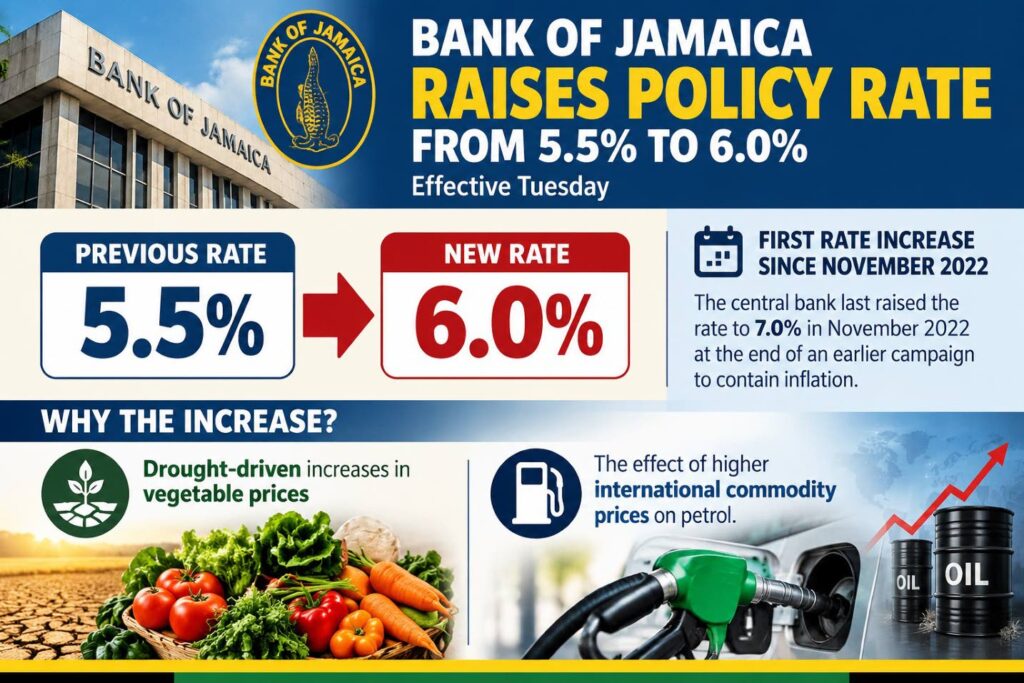
The BOJ raised its policy rate from 5.5 per cent to 6.0 per cent, effective Tuesday. It is the bank’s first rate increase since November 2022 when it raised the rate to 7.0 per cent at the end of an earlier campaign to contain inflation. Rates were subsequently reduced, most recently in February this year, before the BOJ held them steady through August.
Falconer said the bank had little room left to wait.
“At best, the bank could have only afforded one more rate cycle without adjusting its benchmark rate. If current inflationary pressures persist, I expect more tightening in the near to medium term,” he said.
FALCONER... if current inflationary pressures persist, I expect more tightening in the near to medium term
Annual inflation rose from 7.5 per cent in July to 7.9 per cent in August, its third consecutive reading above the BOJ’s 4.0 to 6.0 per cent target range. The central bank attributed the latest rise largely to drought-driven increases in vegetable prices and the effect of higher international commodity prices on petrol. The BOJ said its decision to hold rates in August was appropriate based on the risks it saw then. Since that meeting, it said, escalating tensions in the Middle East and the Russia-Ukraine conflict have kept commodity prices high, while more intense El Niño conditions threaten to prolong increases in local farm prices. Inflation is now likely to remain high for longer than the bank had expected. Its concern is that the increases will spread beyond food and fuel. Core inflation, which excludes agricultural food and fuel, stood at 5.2 per cent in August, unchanged from July but up from 4.2 per cent a year earlier. The BOJ said it was seeing limited signs of higher farm, energy, and transport costs feeding into the prices of processed food and some services. Businesses’ expectations have also risen. In July, they expected inflation of 7.3 per cent over the following 12 months, up from 6.7 per cent in June, according to the BOJ. The bank said businesses were indicating likely wage pressures as well. It noted that it raised rates in part to prevent the current increases from becoming built into future prices and pay demands. Meanwhile, Falconer said the speed of the response recalled the BOJ’s tightening of monetary policy during the height of the COVID-19 pandemic. “I also believe this decision reflects the bank’s perception of the prospect of further deterioration in local and international conditions that affect inflation, and the need to maintain stability in the FX market, particularly given the recent increase in the Fed’s interest rate and their signalling of future rate increases,” he said. The Fed (Federal Reserve or United States central bank) raised its target range by a quarter-point to 3.75 to 4.0 per cent on September 16. The BOJ said global financial conditions had tightened faster than it projected. It expects Jamaica’s exchange rate to remain relatively stable, however, citing healthy international reserves as a buffer against uncertainty. Monday’s announcement does not mean an immediate half-point increase in loan rates for borrowers. The policy rate is what the BOJ pays deposit-taking institutions on balances held at the central bank. Changes in it can influence the rates banks eventually offer customers, but the timing and size of any adjustment to individual loans will depend on lenders and loan terms. The bank now expects inflation to continue rising in the near term before returning to its target range by mid-2027, depending partly on how long the conflicts abroad persist. It also sees potential price pressure from Government recovery spending and the return of activity in sectors affected by Hurricane Melissa. The BOJ said it would use additional measures, if necessary, to contain wider price increases. Its next policy decision is scheduled for November 18.