‘Not an undercover PNP front’
Originally published by Jamaica Observer Read the original
DETERMINED to shake off accusations of political bias and being an organisation that exists mainly to criticise the Government, Fi We Children Foundation is insisting that its criticism of government decisions is driven by its commitment to protecting children’s rights and holding those in power accountable.
The foundation, which describes itself as a non-profit, non-partisan and youth-led organisation, says its public statements are only part of its work, which includes efforts to reduce violence in schools, improve children’s access to proper nutrition and give young people a greater role in decisions affecting their lives.
During a Jamaica Observer Press Club last Thursday, members of its Youth Policy Committee firmly rejected suggestions that the organisation is operating as an undercover political group, with attorney-at-law Antonio Davis saying its purpose is to give children and young people a voice in matters that directly affect them.
“So we would categorically state that we’re not a psyop [psychological operation]. We would categorically state that we’re not an undercover basis for the PNP [People’s National Party], or any party, really. But what it is really, is that I think this foundation gives children the platform.
“Many times, as young people, we’re in the driver’s seat and we’re just passengers watching life go by, and so this platform gives us an opportunity now to kind of hold on to the reins a little bit, hold on to the driving wheel a little bit, and have a voice… So I wouldn’t really say it’s just bashing the Government, but if we see something, then we say something,” Davis said.
The foundation’s members argued that its willingness to highlight shortcomings in government policies should not be taken as evidence of political allegiance. They said the organisation also recognises positive action by the Andrew Holness-led Administration and wants improvements to continue.
Youth Policy Committee member Darrell Scott said the foundation is not opposed to acknowledging government initiatives that benefit children, but believes there is a responsibility to identify areas requiring attention.
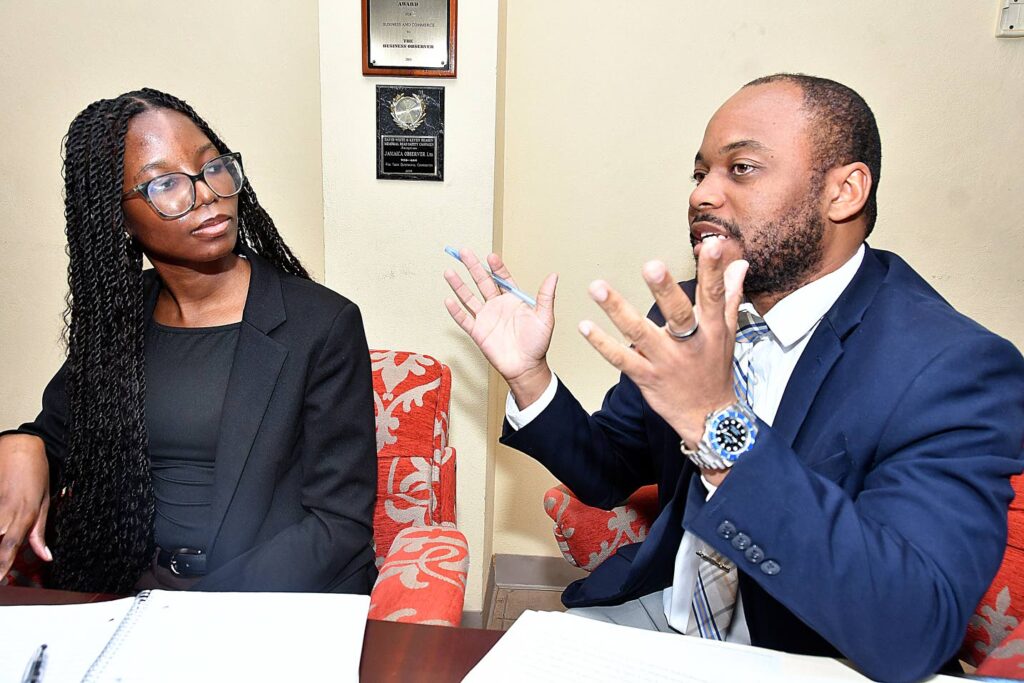
Fi We Children Foundation Youth Policy Committee member Darrell Scott speaking to reporters and editors at a Jamaica Observer Press Club last week.
“So it’s not that we won’t applaud the Government…but I think what we want is the continuation of the good work that the Government has done while also highlighting areas that they may have missed,” he said. Founded in 2019, Fi We Children Foundation emerged from discussions about what its members saw as a gap between policymakers and the issues that matter to children. Scott said the organisation was established to give young people a greater role in representing children’s interests, rather than leaving decisions entirely in the hands of adults. He said its work began before it became more visible in public discussions, with an earlier focus on children in rural Jamaica, who the foundation believes are often overlooked in national conversations. Scott attributed some of the disruption to its activities to the COVID-19 pandemic, while also pointing to the expansion of its team and the increased attention being paid to children’s issues as reasons for its more recent public presence. The organisation now has an online membership of about 215 people and an executive board of four, according to Youth Policy Committee member and law student Jordaina Denton. She explained that it has two main membership categories: General membership is open throughout the year, while applications for the Youth Policy Committee are opened once annually. Denton said applicants to the committee are shortlisted and interviewed, with members expected to take a more direct role in leading advocacy on youth issues. The foundation also runs a programme called Alternative Dispute Resolution (ADR) in Schools, which seeks to equip students with alternative ways of resolving conflicts without resorting to violence. Denton said the initiative was developed against the background of violent incidents involving students, including stabbings and physical confrontations in schools. The foundation also conducts forums involving schools and said it had encountered approximately 10 to 15 schools through its ADR work, although Scott cautioned that the figure was not exact because some schools were reached through forums rather than direct programme activities. Beyond school violence, the organisation has been working on issues surrounding the National School Nutrition Policy. Scott said it had collaborated with the Jamaica Youth Advocacy Network, UNICEF Jamaica and Heart Foundation to advance discussions about children’s nutrition. Another initiative, called Eyes on the Budget, focuses on helping young people understand how public money is allocated and spent. The foundation also appeared before Parliament’s joint select committee reviewing the Child Diversion Act, during which members contributed to the discussions. For the foundation, these projects form part of a wider commitment to children’s rights rather than a series of unrelated activities. Scott said its work is guided by that broad purpose, with particular projects developed to address specific concerns as they arise. However, while the committee members acknowledged that the organisation’s public image has been shaped heavily by its statements criticising government decisions, Denton disagreed that the foundation is failing to promote its other work “We do promote that information, so we have it on our Instagram page. And even when we went to Parliament for the joint select committee, we had done a press release on that. So I think that it is not necessarily that Fi We Children is simply opposing, I think people take it that way because...people are drawn to see a more negative view of things rather than to see the work that we do that does commend people and promote our work,” she said.
