Not passing the buck
Originally published by Jamaica Observer Read the original
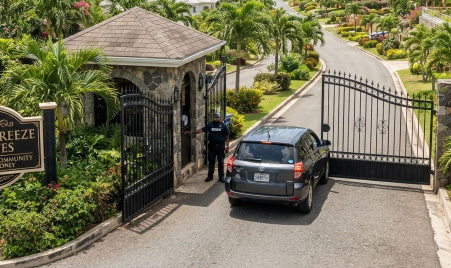
MAYOR of Montego Bay Richard Vernon has rejected the suggestion that gated communities allow the Government to avoid responsibility for maintaining vital infrastructure, instead passing these costs on to residents who pay monthly fees.
“I would respectfully disagree with that suggestion. The St James Municipal Corporation remains committed to serving all communities across the parish, whether gated or non-gated.
The issue is not one of Government avoiding responsibility, but rather of responsibilities being allocated by law among developers, property owners, and local authorities,” he said in a written response to the Jamaica Observer’s Real Estate on the Rock. Adding that these communities are merely a result of growing market demand, the mayor explained the implications of road maintenance behind gates that keep unwanted guests at bay and provide a feeling of exclusivity.
Under the Parochial Act, he said, those who establish, own, and benefit from private roads have a responsibility to maintain them. “Section 40 provides that roads constructed by a developer may only be taken over by the municipal corporation when they have been completed to the required standard and all necessary legal and administrative requirements have been satisfied.
The corporation, therefore, has a responsibility not only to residents of a particular development, but also to taxpayers throughout the parish. “Before assuming responsibility for any road network, we must be satisfied that the infrastructure meets the standards required for public ownership.
This protects both residents and taxpayers by ensuring that public resources are not required to correct deficiencies that should properly be addressed during the development process,” Vernon told the Sunday Observer.
“In many instances, where transfer takes longer than anticipated, the delay arises from outstanding technical, legal or administrative requirements rather than any reluctance on the part of the municipal corporation to assume responsibility,” he insisted.
Meadows of Irwin is among gated communities in Vernon’s parish with unresolved issues that have prevented transfer to the municipal corporation. The citizens’ association estimates it will cost about $5 million to correct two of the major problems.
The mayor said he is working to address the issue. “I wish to assure the residents of Meadows of Irwin that the St James Municipal Corporation values their community and appreciates the strong civic engagement that residents have demonstrated on this issue.
The corporation’s objective is not simply to determine who maintains the roads, but to ensure that any decision taken is in the long-term interest of the community and consistent with the law,” he said. “We remain committed to engaging constructively with the Meadows of Irwin Citizens’ Association, residents, and all relevant stakeholders.
Through dialogue and cooperation I am confident we can identify the most appropriate path forward for the community,” Vernon said. “Ultimately, this is not a question of the corporation versus the community. It is a question of working together to ensure that the infrastructure serving residents is properly maintained, legally compliant, and sustainable for future generations,” the mayor added.
But the problem is a lot bigger than one gated community of about 600 homes. “A number of developments across St James remain at various stages of the handover process.
However, determining the precise number requires careful examination of records relating to subdivision approvals, engineering certifications, land titles, infrastructure completion, and vesting arrangements. In many cases, these records span several decades and involve multiple agencies and administrations,” Vernon conceded.
“Rather than provide information that may be incomplete or subject to revision, I have asked the corporation’s Engineering and Technical Services Department, and the Physical Planning and Sustainable Development Branch to conduct a comprehensive review of the relevant records.
“This review will identify those developments whose roads and infrastructure have not yet been formally transferred to the municipal corporation and will verify the relevant approval and construction dates.
Once that exercise is complete, the corporation will make the information available to the Jamaica Observer in the interest of transparency and accuracy,” he promised. However, the issue is not confined to St James, and neither are the implications.
In many gated communities across Jamaica, where there is no support from the local authorities’ coffers, some residents are reluctant to pay monthly fees, and this eventually becomes blatantly obvious.
“Landscaping deteriorates, potholes appear, walls are not maintained, security can be reduced, and common facilities start looking tired,” said director of Jamaica Homes, Dean Jones. His comments have been shaped by his experience as a realtor associate and particularly from what he has seen first-hand on Jamaica’s north coast.
“Property values do not exist independently of their surroundings. You can have a beautifully maintained house but if a prospective purchaser has to drive through badly maintained roads, blocked drains, and neglected common areas to reach it, that affects the purchaser’s perception of value and, ultimately, what they may be prepared to pay,” Jones stressed.
And there are ramifications for the country’s real estate sector as gated communities become increasingly prevalent. Jones cautioned that buyers need to be aware of the challenges that come with these purchases.
“People sometimes buy the lifestyle being advertised rather than investigating the development itself. A beautiful entrance, guardhouse, swimming pool, and landscaped road can make a very strong first impression, but purchasers also need to ask less glamorous questions: Who owns the road? Who maintains the drain?
Has the infrastructure been completed? Who owns the common areas? What happens when the gate needs replacing? Is there money in reserve? What happens if half of the owners stop paying?
Those questions become much more important as a development ages,” he stressed. People who buy into gated communities also have a decision to make about whether they truly want their developments handed over to the local authorities, lightening the financial burden they now shoulder. As Mayor Vernon pointed out, that would mean ceding some level of control.
“A community may prefer to retain private control and the exclusivity that comes with it, or it may choose to transfer roads into public ownership and benefit from the opportunities associated with municipal maintenance and integration into the public road network. Both options come with corresponding rights and responsibilities,” the mayor said.