NWC seeks 51% hike
Originally published by Jamaica Observer Read the original
The Office of Utilities Regulation (OUR) will decide within 10 days whether to accept a National Water Commission (NWC) application for a tariff review which could pave the way for higher water and sewerage rates.
The OUR confirmed Tuesday in a release that it received the application on Friday, October 16, covering the five-year period from 2026/27 to 2030/31.
The regulator said it would first assess whether the application meets its requirements and may request additional information from the NWC before deciding whether to formally accept it for review.
The development comes as the NWC seeks a 51 per cent increase in water and sewerage rates amid worsening revenue collection and rising expenses.
The utility wants to raise its annual revenue from about $40 billion to $60 billion to cover operating costs and critical investments over the next five years, while noting it owes the Government approximately $21 billion in General Consumption Tax (GCT).
The disclosures were made by NWC officials on Tuesday during a sitting of the Public Accounts Committee (PAC), where the utility’s unpaid bills and financial difficulties came under scrutiny.
Acting NWC President Kevin Kerr told the committee that the proposed increase was included in a tariff application submitted to the OUR last Friday and noted that the commission is awaiting approval from the regulator.
“So what our submission includes is a 51 per cent increase, and there are some scenarios involved if that is not provided; we will have to revise our investment plan, adjust with the determination made at the end of the process and, as usual, the public will be required to participate in a more consultative process by the OUR over the review period,” Kerr said.
Chief financial officer at the NWC Fabian Christie told the committee that the request reflected the utility’s financial challenges.
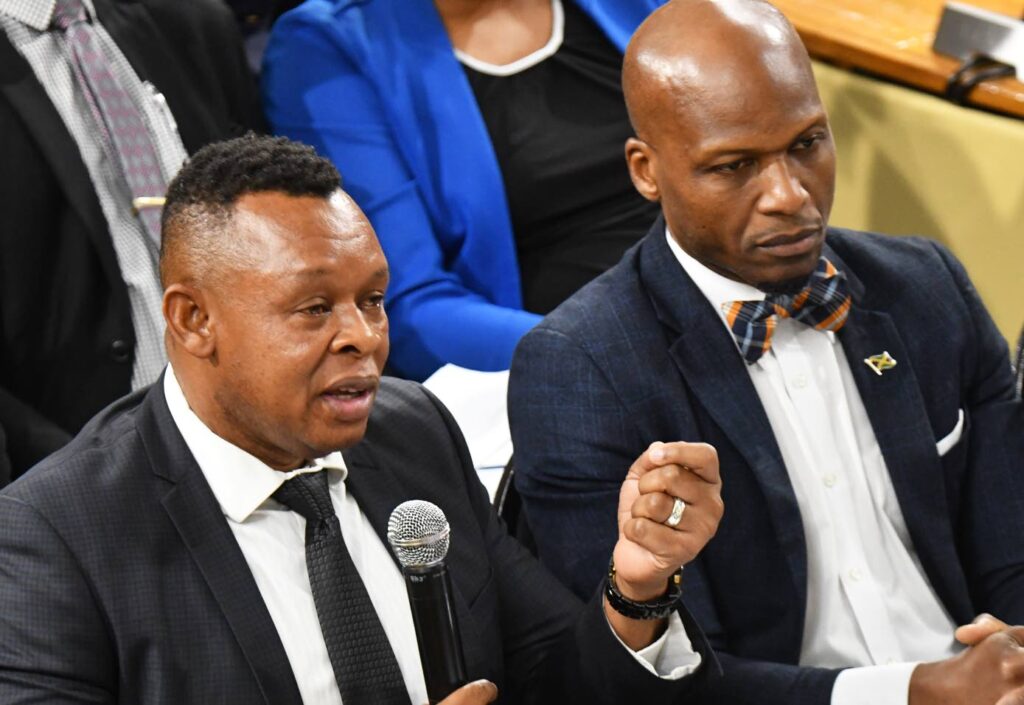
Chairman of the Public Accounts Committee Julian Robinson making a point during Tuesday’s sitting of the committee. (Photo: Naphtali Junior)
“The fact is that our revenues have worsened in terms of paying from our customers, and also the fact that we would require a tariff increase, because our expenses have been increasing dramatically,” Christie told the committee. He also pointed to the impact of natural disasters and worsening droughts on the commission’s finances. Christie said these events could reduce the utility’s revenue by between 10 and 15 per cent in a given year, depending on their severity. The proposed increase comes against the background of a sharp rise in the NWC’s unpaid bills. PAC Chairman Julian Robinson, referring to the Auditor General’s findings, said the commission’s payables rose from $10.6 billion in the 2016/17 financial year to $33.2 billion in 2025/26. The report also found that the NWC’s net receivables — money owed to the utility — stood at $4.6 billion as at March 2026. Christie told the committee that the $21-billion owed in GCT accounted for the largest share of the NWC’s $33.2 billion in payables. He explained that the commission withholds GCT when it is billed by suppliers and is expected to pass that tax on to the Government. Christie also confirmed that the money was being used to support the utility’s day-to-day cash needs. He revealed that the remaining approximately $12 billion in payables includes approximately $6 billion owed to Central Wastewater Treatment Company, which treats much of the sewage from Kingston and parts of St Catherine at the Soapberry facility. The other roughly $6 billion is owed to contractors and suppliers.Chief Financial Officer at the National Water Commission Fabian Christie explaining to the Public Accounts Committee on Tuesday that the tariff review request reflects the utility’s financial challenges. (Photo: Naphtali Junior)
Christie acknowledged that the outstanding payments were affecting the commission’s ability to carry out work. He gave an approximate breakdown of some payments owed to contractors and suppliers, saying about $1.3 billion was between zero and 30 days overdue, $400 million between 30 and 60 days, $500 million between 60 and 90 days, and $1.6 billion outstanding for more than 90 days. The proposed tariff increase is not the only measure being pursued to improve the NWC’s finances. Kerr said reducing non-revenue water was a priority. He said the commission had previously undertaken reduction projects in Kingston, St Andrew and Portmore, and was in the final stage of procurement for an islandwide programme, adding that the NWC hopes to select a bidder or bidders by the end of the current financial period. The planned programme would be rolled out in stages, beginning in areas including Spanish Town, Old Harbour, May Pen, Mandeville, Montego Bay, Negril, Lucea, Ocho Rios, and Port Antonio, before further work in Kingston and Portmore. Kerr said the long-term target was to reduce non-revenue water to 30 per cent islandwide within 11 years as the current level averages between 70 and 73 per cent. The NWC’s financial position was also a concern for Robinson, who questioned how the utility would improve its cash flow beyond seeking higher tariffs. He pointed to the growth in payables and the amount owed to suppliers, while raising the need to reduce losses and improve the collection of money owed to the commission. Christie said the NWC was working on a plan to improve its working capital management, which he expects to submit to the board at the start of next year. He said the effort would need to improve the amount of cash available to meet the utility’s obligations. Furthermore, Kerr said, the tariff application was tied to an investment plan designed to ensure that financing could be secured for priority projects. He noted that the NWC received an interim tariff in 2019, before the COVID-19 pandemic in 2020 eroded its cash flow.

