Restoring sight, reclaiming roots
Originally published by Jamaica Observer Read the original
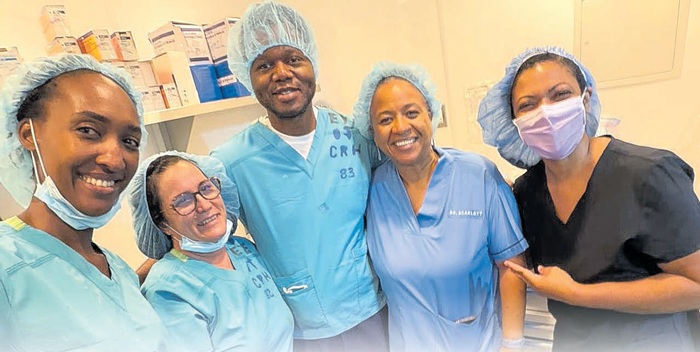
FOR consultant ophthalmologist Dr David Burton, the decision to give back to Jamaica came from an experience he had 20 years ago while he was on an internship at the Kingston Public Hospital.
In 2006, he had travelled to Jamaica as part of the GraceKennedy Birthright Programme.
During a six-week placement at Kingston Public Hospital, he encountered a glaucoma patient whose situation left a lasting mark.
“I remember seeing a patient who had glaucoma who wasn’t taking his eye drops,” Dr Burton recalled.
“I remember saying to him ‘the eye drops will help you keep your sight’, and he said, ‘I can’t afford it.
It’s either buy the eye drops or feed my family’.” For Dr Burton, the contrast between that situation and his experience in the United Kingdom, where he lives, was stark because the health system in his country is publicly funded.
“That resonated with me,” he said.
“It’s something people in the UK don’t have to face.
It drove my passion to want to work and help in the Caribbean.” The father of one said that moment set him on a path that has now come “full circle”.
Nearly 20 years later, Dr Burton returned to Jamaica as part of a self-organised medical mission, working alongside colleagues at Cornwall Regional Hospital in Montego Bay.
“I’ve always wanted to help people,” Dr Burton said simply.
“And I realised that I could bring joy where there’s pain, that’s what I want to do.” Born in the United Kingdom, Dr Burton has built a career in cataract and glaucoma surgery since graduating from university in 2010.
Over the years, he has treated tens of thousands of patients and performed thousands of cataract procedures.
Yet, despite his clinical success, his ambitions have always stretched beyond the walls of British hospitals, to the Caribbean, and specifically to Jamaica.
“Jamaica is a place that has always been in the midst of my identity.
I am naturalised citizen and I met my wife, Carla, here in 2008 while we were at the diaspora conference.
We got married here in Jamaica in 2010.
It’s a home away from home to me,” he said.
He added, “There’s something that’s pulling us there.
I feel a strong affinity and pull to the people of Jamaica.” Dr Burton’s most recent visit was driven not by formal programmes of the conference, but by personal initiative.
After attending a diaspora conference, he began reaching out to contacts within Jamaica’s Ministry of Health and local medical professionals.
And on June 16, hosted a medical mission at the Cornwall Regional Hospital where he treated patients with various eye issues.
“I just did the background work myself,” he said.
“I asked, ‘what’s needed? How can I assist’ and from there I started organising the medical mission.” The ophthalmologist who specialises in treating glaucoma added that there was untapped potential of diaspora partnerships.
While he acknowledged the presence of existing medical missions, Dr Burton argued that more coordinated efforts could significantly improve outcomes.
“It would be good to understand what is happening, where, and at what level,” he explained.
“If you can map that out, you can identify the gaps, then the diaspora can help fill them.” He envisions a system where expertise and resources from overseas professionals are strategically aligned with local needs, creating a more effective healthcare network across the island.
Although there are challenges Dr Burton remains energised by the human impact of his work.
“When patients come back after surgery, they’re happy and delighted,” he said.
“If I can give people their sight back, or protect it, that’s the gift for me.” He describes the experience of working in Jamaica as deeply fulfilling, not just professionally but personally.
“It’s the people, the stories, the culture,” he explained.
“There’s an entrepreneurial spirit here.
The people who don’t have will try to have, and those who have will try to help others.” This spirit, he adds, extends into professional life, where collaboration often feels more organic than in the UK’s more bureaucratic systems.
“You make one call, and that person knows someone else, and suddenly things happen,” Dr Burton said.
“That networking aspect is powerful.” Looking ahead, Dr Burton hopes to spend more time working in Jamaica and contributing to its healthcare development.
He believes that improving infrastructure and access to care will not only benefit residents but also encourage greater diaspora engagement.
“One of the concerns people have when returning is healthcare,” he noted.
“There’s a need to develop a system that works for all.” He is particularly interested in helping design more efficient approaches to service delivery, including better understanding of demand and supply across different medical areas.
“It’s about identifying priorities,” he said.
“Where are the gaps? How do we bridge them?” For Dr Burton, the mission is deeply personal, and notably, entirely self-funded.
“This work was done pro bono,” he explained.
“It’s all paid for out of pocket.
My desire is just to help the people in Jamaica.” Managing Director of JN Life Insurance, Hugh Reid, commended Dr Burton for his decision to give back to Jamaica.
“Stories like Dr Burton’s highlight the power of purpose-driven expertise and the critical role of diaspora professionals in strengthening healthcare systems,” said Reid.
“Access to quality eye care is not just a medical issue, it’s directly tied to financial security and quality of life.
When individuals can preserve their sight, they maintain their independence, their livelihoods, and their ability to support their families.
Dr Burton’s decision to give back to Jamaica in terms of helping those with eye conditions is commendable and will help to build a healthier and more resilient Jamaica.” Interestingly, Dr Burton’s decision to help people as a doctor came from his childhood fascination with human physiology.
As a child his mother bought him books on the subject and each volume came with a model human organ to be assembled.
He recalls an early moment, at age eight or nine, when he tried to explain a heart attack using a book model during a family emergency.
“My uncle was having a heart attack and I came downstairs with my book saying he is having a myocardial infarction.
They were all worried he was going to die and so were wondering why I was excited.
But, I was just describing what had happened,” he says.
“But it brought some joy to the room,” he shared.
“From then on, I decided that I wanted to be a doctor so I could bring joy by helping others to get well.” Now, as he balances his work in the UK with growing commitments in Jamaica, Burton sees his efforts as part of a larger story, one of connection, contribution, and coming home.
“Why do I want to return?” he reflects.
“Because that’s where I feel my identity lies.”