Samuda sounds alarm on climate financing shortfall
Originally published by Jamaica Observer Read the original
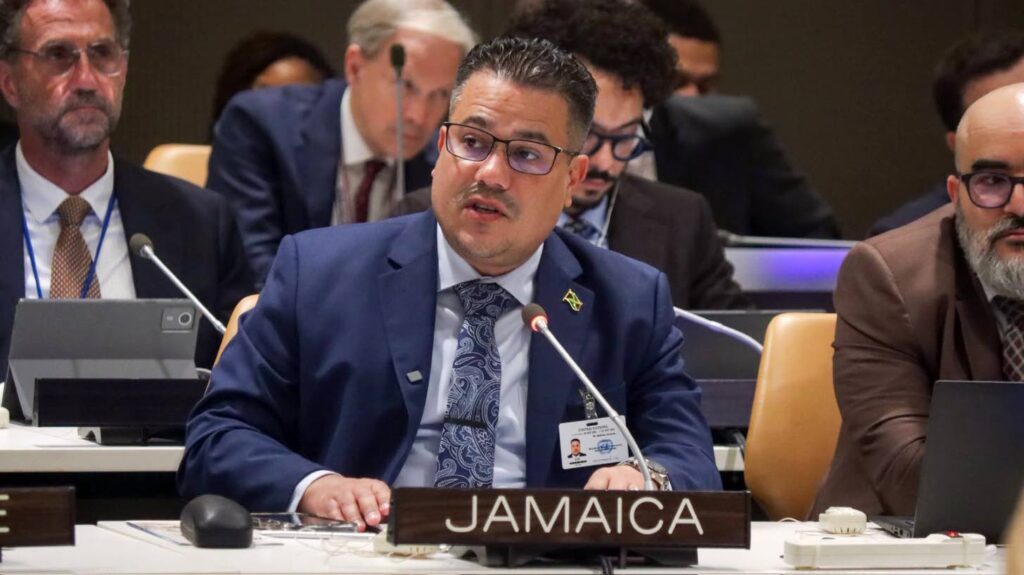
AS small island developing states, including Jamaica, bear the financial and environmental brunt of worsening weather conditions, Minister of Water, Environment and Climate Change Matthew Samuda has called for greater international financing for climate adaptation.
Speaking Tuesday at the United Nations’ Solutions Dialogue on Financing Adaptation in the Era of Overshoot, hosted in New York, Samuda argued that current global funds do not meet the scale of the threat faced by vulnerable countries.
He pointed out that the World Bank’s assessment is that Jamaica needs about US$5-billion to strengthen its water sector alone, against climate and development challenges.
The minister noted that in the last five years, Jamaica experienced four of its five worst droughts, and its hottest and wettest days on record, and the island’s western parishes were battered by Hurricane Melissa last October — the strongest storm to hit the country in history.
Additionally, Samuda pointed out that the onset of the El Niño climate phenomenon has contributed to worsening drought and heat conditions affecting the island.
Samuda argued that these extreme disruptions are undeniable proof of global climate overshoot and argued that developing countries lacked the funding required to fortify their resources against the environmental crisis.
“In the case of Hurricane Melissa last year, it was US$12.2 billion, 56 per cent of [Jamaica’s] GDP [gross domestic product]. When one compares that to something like Hurricane Katrina (2005), which was one per cent of US [United States of America] GDP, then you understand that the impact of overshoot affects us disproportionately, and that is of course a concern in the entire developing world,” said Samuda.
According to the United Nations Environment Programme (UNEP), climate overshoot occurs when global temperatures temporarily go past the Paris Agreement’s international goal of 1.5°C of warming, staying hot for several decades before potentially falling below it.
However, scientists warn that prolonged warming above that level could result in melting polar ice sheets, irreversible biodiversity loss and other long-term changes.
Currently, UNEP predicts that the Earth is on a trajectory to cross 1.5°C global warming within the next few years, with its report putting the best case scenario at 1.8°C; while other sources suggest a peak at 2°C.
“Now, adaptation is critical, because without...the right adaptation funds being allocated and deployed in the best way possible, you’re going to have a greater need for capitalisation of the Loss and Damage Fund. That is the reality. We can’t function with a fund that doesn’t have funds, so it already needs to be capitalised,” argued Samuda.
“The adaptation funds available to the developing world simply don’t scratch the surface. Then we have the issue of whether or not we’re deploying them as efficiently and as quickly as we absolutely need to, because every dollar not deployed, staying in a bank account not going into wider drains, better coastal development, [and] stronger housing infrastructure, will contribute to greater losses and loss of life,” he said.
While the water minister extended his gratitude to the Green Climate Fund (GCF), which recently approved a US$50-million investment to advance resilient agricultural practices in Jamaica, he noted that funding was still severely lacking.
He added that Jamaica has developed its Systemic Risk Assessment Tool, and is in the process of finalising its national adaptation plan but these strategies will require increased investments.
From a political perspective, Samuda maintained that a greater effort must be made to get other agencies to value resilience, pointing out that they have the capacity to action change by investing in adaptation-related financing.
“We simply need the political will to finance adaptation. That is a core of the issue, because we don’t need to be overly creative, the industries that will be affected, certainly the general insurance industry, has the capacity to significantly increase... [and] has the capacity to invest in adaptation-related financing,” he said.
“Another industry that creates collectible opportunities, it’s calculable and collectible, because of IATA (International Air Transport Association), is certainly the airline industry. There were five billion passenger trips last year. Certainly a dollar per passenger trip would not trigger global inflation. So the issue is an issue of political will,” charged Samuda.