Sykes laments incomplete court infrastructural works
Originally published by Jamaica Observer Read the original
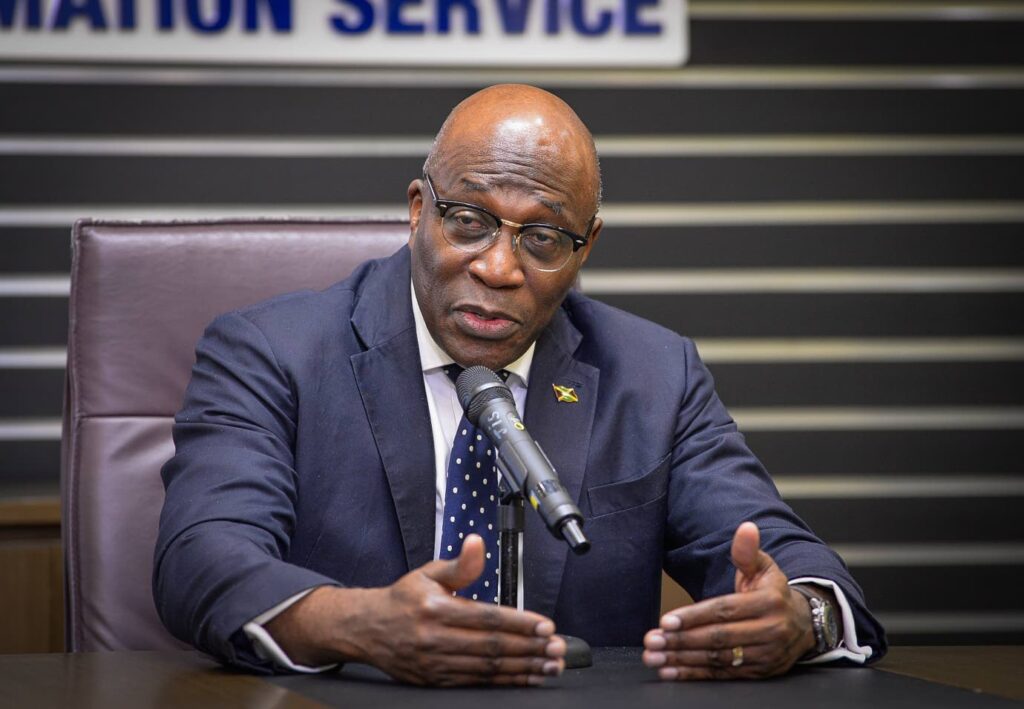
HEAD of the judiciary Chief Justice Bryan Sykes says with the Government is on its “third strategy” to produce new courtrooms, long-standing infrastructure challenges which have humbugged several courts across the island must also be resolved so that trials can take place within a suitable time frame.
According to the chief justice, the Supreme Court in downtown Kingston, the Family Court also in downtown Kingston, the Family Court in St James, and the Manchester Parish Court in Mandeville are prime examples.
“Last year before Hurricane Melissa arrived, a contractor turned up at the Supreme Court and began some work, well, would you believe one year later the work hasn’t finished, I have not seen this contractor for the last six or seven [months]. I don’t know what has become of the contractor, I don’t know whether he is dead or alive and the consequence has been that one of our courtrooms in the Gun Court [Division] has been out of commission because they have to house the staff, the Supreme Court is literally bursting at the seams, so we had to house them in that court while the contractor commenced his work on the room near to the library upstairs,” the chief justice shared. He said subsequent rains led to the flooding of the library.
“Since about February/March or so, the contractor has simply disappeared and the work is still unfinished and so consequently, we are one courtroom less and so three judges we would have had sitting there are down to two. So when you have legislation that does not incentivise guilty pleas and you are one courtroom short, why are we surprised that the clearance rate is 66 per cent,” Sykes stated.
Justice Sykes, in pointing out that incomplete infrastructural works contribute to backlog issues, emphasised that renovations handled by the Court Administrative Division do not produce “the same difficulties”.
“Infrastructure is very, very important for the members of the public, [and] the members of staff and I come back to the Traffic Court near to Sabina Park, we now know that no construction can go on the floor above because the building was never constructed to take that even though that was the plan, the engineers have advised us that it can’t support any construction on the top there. So, too, the Family Court that is on Duke Street, I think it is one of our most distressing situations; I don’t know if you have ever passed there sometimes and you see the mothers, in particular, standing up outside in the sun, it’s just simply undignified and really we must treat our citizens better than that,” Justice Sykes declared.
Said the chief justice: “There is no reason why in the 21st century because you come to court you have to be standing up outside in the hot sun and that kind of thing for extended periods of time because of inappropriate accommodation. So, too, the Family Court in St James, which I have said before was intended to be temporary. It is still on the plaza. We have court on the plaza in Mandeville and it is really thoroughly unsuitable and I keep coming back to this because what I have observed is that once the immediate crisis has passed, attention and focus shifts somewhere else — and we don’t want to end up like the court in St James where the persons who went there to work in their 20s have now reached retirement age and they are still on the plaza. So that is something that really needs to be addressed”.
Added Justice Sykes: “Now how they are going to address it? [It has moved] from the Government making the building to public-private sector partnership and now we are hearing about NaRRA [the National Reconstruction and Resilience Authority]. So this is the third strategy to have the new courtrooms, let us hope that NaRRA succeeds where others have failed”.
His remarks came following the swearing-in ceremony for six judges who have been appointed to act in higher offices for the Michaelmas term at King’s House in Jamaica on Monday. During the ceremony, which was presided over by Governor General Sir Patrick Allen, Supreme Court Judge Justice Carolyn Tie-Powell was once again appointed to serve as a judge of the appeal, effective September 20 to December 18 this year. She will act in the absence of Appeal Court Judge Justice Nicole Foster-Pusey who is on vacation leave. In the meantime, puisine judges Kamar Henry-Anderson and Jacqueline Wilcott will act in place of Justice Opal Smith and Justice Andrea Thomas who are on vacation leave, with effect from September 16 to December 18 this year. The appointment of Christine McNeil and Yvette Wentworth-Miller as acting masters-in-chambers will also be in effect from September 16 to December 18. On Monday, Sherrine Reddie was appointed to fill an existing vacancy.
Justice Tie-Powell, responding on behalf of the appointees, emphasised the importance of judges being in the best mental and physical shape to undertake their duties, noting that oftentimes disturbing details of the cases handled follow judicial officers long after they have disrobed.
Highlighting the recent passing of several active members of the bench, all of whom she had worked alongside, Tie-Powell said the importance of wellness has never been more obvious.
“I join with the chief justice — the physical condition of our workplace is far more than a matter of aesthetics. It is fundamental to our well-being and directly affects our capacity to perform our duties effectively. Our judiciary is strong but we must nurture that strength. An investment in judicial wellness is ultimately investment in the quality of justice itself. For a well-supported judiciary is essential to discharging its constitutional mandate effectively,” she said.