The Cost of Silence: What St Lucia’s services exporters need to know
Originally published by Caribbean News Global Read the original

-
- Should the UK dictate Saint Lucia’s economic diplomacy and trade in services?
By Caribbean News Global
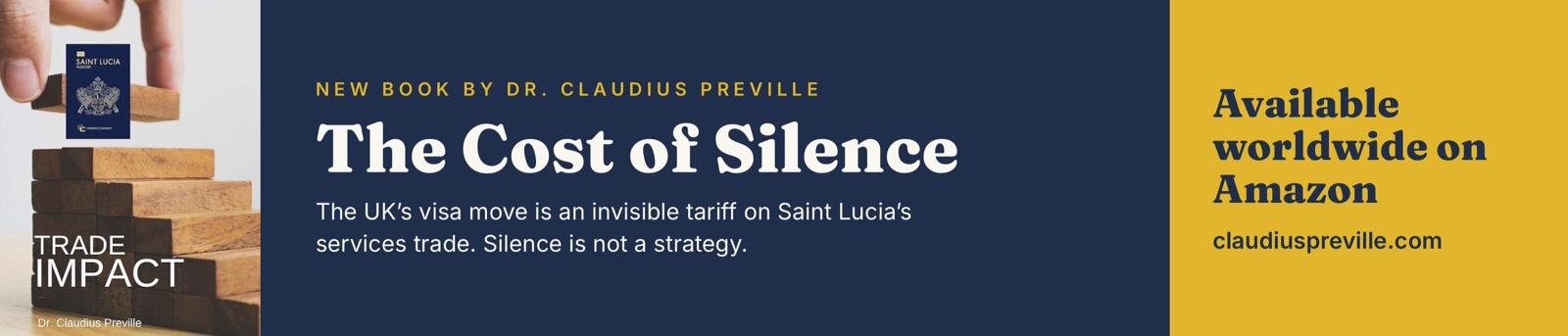
CASTRIES, St Lucia – In The Cost of Silence: What the UK’s Visa Move Means for Saint Lucia’s Trade in Services, and Why a Response Is Urgent, Dr Claudius Preville examines the economic fallout of the UK’s March 2026 decision to impose a unilateral visa requirement on all Saint Lucian passport holders. For the Saint Lucia economy, five key takeaways outline what this means for an economy that is more than 85 percent services — and why a structured response is urgent.
The Cost of Silence shapes several critical realities and strategic alternatives Saint Lucia’s service exporters need to know. Let’s dive into four metrics for policymakers, assertive economic diplomacy and global trade dynamics.
- Visas act as “invisible tariffs” on services
Mobility equals market access: Unlike goods-based economies where tariffs are visible and negotiated at the border, a services-based economy relies on the movement of people. Saint Lucian consultants, legal experts, financial advisors, and technical specialists, delivering high-value services overseas, heavily rely on Mode 4 trade (the temporary movement of natural persons) to deliver expertise, attend meetings, pitch clients, and build trust.
Higher costs and lost contracts: Imposing visa requirements introduces administrative delays, application fees, and uncertainty, effectively acting as a hidden tariff that inflates the cost of doing business and quietly shuts Saint Lucian professionals out of the UK market.
High-level advisory work – face-to-face is built on trust, relationship-building, and physical presence in the boardroom. A unilateral visa requirement introduces weeks of administrative drag, unpredictable processing times, and outright refusals.
- Silence is a costly policy choice
Setting a dangerous precedent: Accepting unilateral restrictions without a formal diplomatic or policy response signals to trading partners that Saint Lucia’s market access can be curtailed without consequence.
Lost bids, agility, trust deficit: When a UK firm needs urgent technical expertise for a regional project, they cannot wait for a Saint Lucian consultant to navigate months of bureaucratic hurdles. The visa requirement essentially sidelines Saint Lucian professionals, handing a structural advantage to competitors from jurisdictions with minimal friction travel arrangements. As Dr Preville summarises: “A market you cannot reach is a market you do not have.”
Erosion of exporter confidence: Dr Preville warns that failing to defend citizens’ ability to trade undermines domestic confidence, sending a message to local professionals and service firms that their work and international competitiveness are secondary priorities.
- The case for reciprocity and leverage
Moving beyond grievance: Small island states cannot shift the policies of larger economies through appeals to goodwill alone; instead, they must exercise agency and leverage.
Reputational Friction: Beyond individual contracts, the visa requirement casts an unmerited shadow of friction over Saint Lucian firms, signalling to international partners that sourcing talent from the island is complicated and risky.
Answering “like with like”: Dr Preville argues that reciprocity—matching access with access, and restriction with restriction where necessary—is the baseline requirement for fairness in international trade. Even if speaking up carries short-term diplomatic friction or risks to inbound tourism, the long-term cost of surrendering market access is far steeper.
- Looking beyond the visa: A 10-year agenda
Strategic diversification: The UK visa issue should serve as a catalyst rather than the entire conversation. Exporters and policymakers must look toward a broader, 10-year services trade agenda that institutionalises reciprocity, leverages regional CARICOM frameworks, and strengthens Saint Lucia’s identity as a proactive, sovereign trading nation.
Assertive economic diplomacy
First, inaction and silence in foreign trade policy carry a severe cumulative cost. Saint Lucia should evaluate matching administrative or entry requirements where feasible and strategic. Even the posture of reciprocity signals that unilateral trade restrictions carry a diplomatic and political cost for the imposing partner.
Second, accepting unilateral restrictions sets a precedent that degrades Saint Lucia’s market access over time. Individual island economies have limited bilateral leverage against major global powers like the UK. Policymakers must integrate a broader 10-year trade framework. This means aggressively diversifying export markets, shifting toward digital and remote service delivery where physical borders matter less, and building robust legal protections under existing trade agreements (CARIFORUM-UK Economic Partnership Agreement).
Third, Dr Preville argues that small island developing states (SIDS) cannot rely on traditional diplomatic patience when their market access is unilaterally dismantled. His recommended agenda centers on active, structured statecraft: there is a strategic need to move toward a structured, digital-first services export economy backed by active economic diplomacy.
Regional linkages
- Border security, investment, diversification, AI, and macro pressure
Caribbean News Global frequently spotlights institutional modernisation and cross-border cooperation. Recent coverage highlighted bilateral customs cooperation between Jamaica and the United States aimed at strengthening border security.
- The theme of economic resilience and small-state realities often focuses on how smaller economies handle external shocks, inflation, and structural changes. Caribbean News Global published strategies —such as “Beyond Gas: Building Trinidad and Tobago’s next growth engine“ and commentary on small states in global forums like COP—underscore a focus on diversification and institutional voice.
- On monetary policy and aid, IMF deputy managing director Nigel Clarke’s remarks on Latin American inflation targeting, and the FAO urging job creation and coordinated action to combat hunger and poverty. The Cayman Islands noted a 5.7 percent second-quarter inflation rate.
- Nevis hosts US veteran delegation to explore investment in tech, finance, health, and logistics.
- During a meeting with the European Union Delegation in Guyana, officials pitched major infrastructure investment opportunities to approximately 15 companies. The engagement focused on avenues for international participation in key national projects across transport, energy, healthcare, tourism, and connectivity.
- FocusEconomics highlighted what president Luiz Inácio Lula da Silva’s fourth term means for Brazil’s economy, cites, inflation and interest rates, GDP growth and fiscal policy.
- Sir Ronald Sanders on the challenges small states face in international climate negotiations, headlined: Why consensus does not always serve small countries: the COP experience.
- Trinidad and Tobago keeps emphasising the importance of AI in enhancing government services. Senator Dominic Smith, minister of public administration and artificial intelligence, outlined the potential of AI to enhance public service delivery in Trinidad and Tobago.
- Anthropic co-founder Jack Clark maintains a human approach.
As summarised by Dr Preville:
“Predictable market access is essential for service exporters competing in global markets. The focus should be on safeguarding professionals’ ability to deliver value abroad while strengthening long-term competitiveness at home. When visa fees, processing delays, and uncertainty arise, they function as non-tariff friction (“invisible tariffs”) that increase operating costs and slow response times on international mandates.”

Global trade dynamics
- High-stakes diplomacy, global migration and cost reduction
On Saint Lucia’s CBI diplomacy, prime minister Philip J. Pierre continues to navigate high-stakes diplomatic talks with Brussels regarding St Lucia’s Citizenship by Investment (CBI) program. https://caribbeannewsglobal.com/st-lucia-navigates-high-stakes-cbi-diplomacy-with-brussels/
At the EU- UK Summit 2026 in Brussels, UK prime minister Andy Burnham, agreed to a landmark package with the European Union.
“It directly addresses the biggest challenges of our times and the biggest worries that people have: the cost of food, the cost of energy, the lack of growth in the economy and the cost of doing business, the levels of illegal immigration and the challenges facing our young people,” prime minister Burnham, said. The deals agreed could add up to 0.5 percent to UK GDP by 2040, equivalent to around £17 billion a year for the UK economy.
Core Takeaways
External pressure on small open economies shows up clearly in diplomatic and trade realignments.
Prime Minister Andy Burnham’s EU–UK trade package in Brussels illustrates how major trading partners prioritise lowering their own export costs and domestic pressures. Meanwhile, analysis of external pressure on small states reinforces why passive reliance carries steep long-term risks.
The high ‘Cost of Silence’: Why St Lucia must act on visas and services trade reform argues the multiplier effect and reasons to pivot sustainable growth models beyond CIP/CBI. The Caribbean region’s increased reliance and external risks highlight the need for deeper analysis of goods and services trade patterns.
‘The EU threat and the economic bullying of small states’ by Nigel Edwin, inquired:
“How does the EU reconcile its commitment to sustainable development through such arrangements with demands that could undermine the fiscal stability of its smaller development partners?”
External pressure on small open economies shows up clearly in diplomatic and trade realignments. Caribbean regional integration must enhance resilience, shifting toward services, digital trade. and artificial intelligence.
- A non-tariff barrier—an ‘invisible tariff’—hampers market access, competitiveness, and trust.
For Saint Lucian consultants and the service trade industry, the takeaway is urgent: treat non-tariff mobility barriers as a structural business risk, expand digital and regional channels, and push for a coherent trade strategy that goes beyond short-term fixes or CIP/CBI dependence.
The Cost of Silence explores the effects on small open economies, as well as the policy context of institutional measures.
You can find Dr Preville’s book on Amazon.