Trinidadian gov’t plans to reopen oil refinery
Originally published by Jamaica Observer Read the original
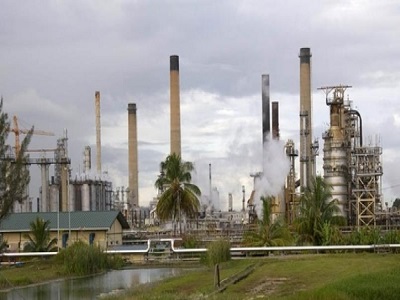
PORT OF SPAIN, Trinidad (CMC) — The Trinidad and Tobago Government says it intends to restart the Petrotrin oil refinery that was officially shut down on November 30, 2018, by the Keith Rowley administration due to billions of dollars in debt and operational losses.
The previous government had said that the 101-year-old refinery had accumulated an estimated TT$12 billion (One TT dollar=US$0.16 cents) in debt and lost about TT$8 billion over a five year period.
But as he delivered the TT$63.3 billion national budget to Parliament on Monday, Finance Minister Davendranath Tancoo said that the energy sector remains the main pillar of the country’s economic strength.
“It is the key ingredient for our diversification thrust. Over 70 per cent of our foreign exchange earnings come from the export of energy commodities. It is this very income which facilitates the operations and development of our non-energy sectors,” he added.
Tancoo told legislators that the state-owned Petrotrin Refinery is more than just reviving a dormant industrial asset to protect fuel security.
“This is about reinstating the very lifeline to communities, downstream contractors, micro-enterprises, doubles vendors, roti shops, etc. Thousands of residents in communities from Couva to Cedros were suddenly left traumatised by a loss of income to meet the needs of their family since 2018.”
Tancoo said that when the refinery was shut down, the country moved from being a net exporter of refined products to having to import every single litre of diesel, of gasoline, of pitch oil and of engine oil used in this country.
“We will restart the refinery. We are advancing the phased restart of the Guaracara Refinery at Pointe-a-Pierre. Following receipt of the Comprehensive Report of the Refinery Restart Committee, the Government is evaluating proposals from a shortlist of serious local and international investors.
“Let me be clear, we will approach the restart of this national asset with fiscal discipline. Our objective is to secure a credible, commercially viable and fully financed arrangement that protects the national interest while creating the conditions for renewed economic activity.
“We will return economic momentum and restore confidence in many communities linked to the refinery and dependent on the energy sector,” Tancoo said.
Tancoo said that the previous government, which was voted out of office in April 2025, had hinged the entire energy sector on the Dragon Gas field, located in Venezuela's territorial waters in the Caribbean Sea, just across the maritime border from Trinidad and Tobago.
The finance minister said that despite multiple excursions to Venezuela, the last government “came back with nothing”, accusing the previous administration also of orchestrating “the precipitous collapse in natural gas production and consequently that of LNG and petrochemicals which the country is grappling with today”.
But he said natural gas supply today “stands at a meagre 2.4 bcf”, adding “this is a staggering 45 per cent collapse in our natural gas output, causing the permanent closure of Atlantic LNG Train 1 and several other petrochemical plants.”
“Today the Point Lisas Estate is almost a ghost town and even those plants still operating are producing significantly below capacity. They have devastated our energy security, but we are fixing it.”
He said reigniting the natural gas supply was the Government's first priority, adding “we immediately engaged all the major energy stakeholders to revive growth of this vital sector”.
He said that the Government has since established the Energy Accelerator Hub within the Ministry of Energy and Energy Industries to fast-track all regulatory, logistical and administrative approvals for major energy investments to move from project concept to production.
“This now brings under one umbrella institution 33 separate approvals across eight ministries and agencies, reducing delays that compromised investment and postponed production. Independent analysis shows that shortening project timelines by just one year can unlock approximately US$120 million in value.”
Tancoo said that to date, new gas supplies have come from bpTT’s Cypre project. In addition, the EOG-operated Mento development project has achieved first gas, reaching peak production of 281.58 million scf per day in June 2026.
He said the bpTT Ginger is targeted to deliver first gas in the first quarter of 2027, with projected peak production of 335 million scf per day, while Mahogany A Extended Field will deliver first gas in 2027 with an expected peak of 200 million scf per day.
Tancoo said Juniper Phase II will deliver first gas in 2027 with peak production at 272 million scf per day, Angelin Extended Field is currently producing 127 million scf per day, while Manakin-Coquina will see a final investment decision in November 2026.
The finance minister said that Mento Phase II is expected to produce 225 million scf per day when it comes on stream; Coconut is expected to deliver first gas in 2027 with peak production estimated at 300 million scf per day; Aphrodite is expected to come on stream in 2027 with a production of 100 – 130 million scf per day; and Manatee Plus is expected to produce first gas in late 2027 with peak production of 600 million scf per day.
“This is all in 2027. There are several other ongoing initiatives in the pipeline that will contribute additional gas to the industry,” he said, telling Parliament that bpTT has secured an exploration and production license for Loran Phase II, which places this country in a strategic position to monetise potentially more than four trillion cubic feet of natural gas from several cross-border and regional fields using the country’s existing energy infrastructure.
“Furthermore, bpTT has agreed to acquire Woodside’s 70 per cent stake in the Calypso Gas Field, giving bpTT full control of one of this country’s largest undeveloped gas discoveries. This is expected to close by the end of 2026 and will significantly strengthen the country’s long-term gas supply and export outlook.
“Negotiations are well advanced with Shell and other energy companies for the further exploitation of cross-border and deep-water gas.
Tancoo said the Government had secured a potential US$21 billion investment in oil exploration and production with ExxonMobil.
“The ExxonMobil 3D seismic acquisition programme is now completed and an analysis of the data to identify potential drilling targets within the ultradeep-water block is at an advanced stage. Not surprisingly, we now have interest from other major international operators, including Chevron, Curlew Mid-stream and Occidental Petroleum. This further demonstrates renewed confidence in Trinidad and Tobago’s energy potential.
“Major international operators are once again investing substantial capital in exploration, development and production activities in Trinidad and Tobago. Upstream capital expenditure is estimated to exceed US$2 billion in 2026, with further investments projected at US$2.3 billion in 2027, US$2.6 billion in 2028 and US$1.4 billion in 2029.”
Tancoo said that these investments will support the development of new oil and gas resources, expand offshore infrastructure and optimise mature producing assets.
He said the Government is also incentivising smaller foreign and local private operators to develop and monetise our marginal oil reserves.
“In addition, we are making direct investment through Heritage Petroleum Company Limited, which is executing a drilling and workover programme across producing fields, including East Soldado and South West Soldado,” Tancoo told legislators.
Debate on the budget will begin on Friday.
