Virtual reality delivers strong results at Seaforth High
Originally published by Jamaica Observer Read the original
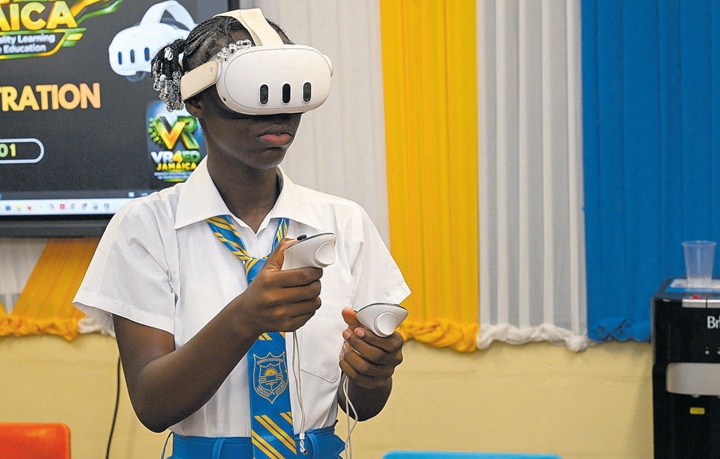
SEAFORTH High School in St Thomas is stepping out of traditional textbook learning and into the future through the use of virtual reality (VR) in the classroom.
The technology, which has been incorporated into subject areas such as information and communications technology (ICT) and business management, is not only boosting student interest and engagement but is helping to drive academic passes at the institution.
Business and information technology (IT) teacher at the school Terron Strachan, who is leading the charge, says VR is “a new way of learning”.
VR leverages immersive stimulation to bridge the gap between abstract concepts and real-world applications, allowing students to form a deeper connection with their subject matter.
Strachan notes that VR enables students to touch and move items without physical possession, offering a cost-effective solution for resource-constrained schools.
“Having a system where the students are immersed in a virtual world and they can take up a processor or take up a graphics card and put it into a computer in the virtual world, it’s a really different experience and… it really gives them a greater connection with the subject,” Strachan pointed out.
He cited studies showing that students are less distracted in the virtual world and are more focused on the subject area.
Furthermore, the students are naturally drawn to technology, considering the current and ever- evolving digital age.
“They like their phones.
They like their tablets so why not create a space where we can reach them more? We can bring the lesson in such a way that they are more interested.
As a connectivist — which is someone who believes strongly in the use of technology to enhance learning — it’s very important to have a system like this for the students,” Strachan said.
The impact of VR technology at Seaforth High speaks for itself, with improved passes in Caribbean Secondary Education Certificate (CSEC) exams.
“The passes for IT before I came were at about 56 per cent.
Last year my passes were 100 per cent in IT with a slight dip this year to 85 per cent.
However, for management of business, we moved from 34 per cent to 80 per cent last year when I came and 100 per cent for this year.
I attribute the passes to the use of technology,” said Strachan, who has been at Seaforth High School for just two years.
The school is now in the process of acquiring additional VR headsets so that each student in a class will be able to have a device and the entire classroom can be connected during a lesson.
Strachan pointed out that not all lessons are taught using VR, as the technology is used for certain topics and for specific ways in which some pupils learn.
He has conceptualised ‘VR4ED Jamaica’ — a vision for all educational institutions in the country to embrace VR as a learning tool.
Strachan noted that the undertaking will require investment in the acquisition of equipment such as headsets and training of teachers and students.
“The benefit that comes from VR is far greater than the cost, because at the end of the day, if we reach one learner, it makes a big difference,” argued Strachan.
The innovative teacher, who recently received the Ministry of Education, Skills, Youth and Information’s Region Two Spirit of Care Award for Innovation, also uses artificial intelligence (AI) in his classrooms.
He has his own AI assistant that carries out different functions like grouping students for activities, controlling lights and sound and sending reminders for general classroom management tasks.
“It’s a whole ecosystem.
She controls the TVs; she can turn them on and off.
So, it’s really interesting with what she can do and with using technology in the space,” said Strachan.
The dedicated educator, who previously worked in the corporate world, said that over his two-year tenure at Seaforth High and stewardship of the ICT Club, 15 different awards have been won by the school and its students.
“The students are the reason why I do what I do.
I think that what is different from in the corporate world was that you’re letting companies make a lot of money, but I’m actually here impacting lives and helping the students and it means more to me,” Strachan added.
Grade 11 student Jevonte Hamilton said VR is making a big difference in his learning experience, helping him to focus more on his lessons.
“Traditional classroom [learning] is not really my thing but ever since I have been using VR, I’ve been learning a lot in information technology and other technology subjects,” said Hamilton, who described VR as a more fun way to learn and experience how things work.
Seaforth High’s IT lab, which houses its VR technology, will be equipped with AI-powered air-conditioning units, which the school won in Wisynco’s ‘Hydrate to Educate’ competition that Strachan entered.