Wage bill watch
Originally published by Jamaica Observer Read the original
The Government has set aside $42.8 billion to cover new public sector wage rates and retroactive payments, but the Independent Fiscal Commission (IFC) says it cannot determine whether the provision will be enough to settle the outstanding claims across State agencies.
The uncertainty comes even after the Government reached a three-year wage agreement with the Jamaica Confederation of Trade Unions (JCTU), with the fiscal watchdog warning that negotiations with other bargaining groups could add further pressure to the wage bill.
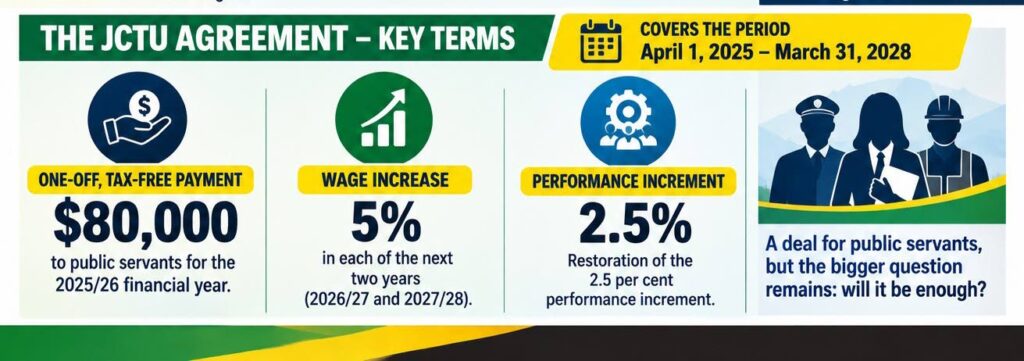
The JCTU agreement, formally signed on August 27, covers the period April 1, 2025 to March 31, 2028. It provides for a one-off, tax-free payment of $80,000 to public servants for the 2025/26 financial year, followed by a five per cent wage increase in each of the next two years, as well as the restoration of the 2.5 per cent performance increment.
The IFC said the settlement was reached well into the three-year period and has introduced uncertainty into a budget that had been prepared on the basis of a smaller wage increase.
“In addition to the IFC being unable to assess the fiscal impact of the compensation agreement in the absence of pertinent information on the cost of the wage settlement relative to the initial offer from the ministry, there is also uncertainty on whether the $42.8-billion contingency allocated to cover wage rates and retroactive payments is adequate,” the IFC said in its latest Statement on Fiscal Performance tabled in Parliament last week.
The Government’s original wage offer, which was incorporated into the 2026/27 Budget, provided for an annual 2.5 per cent increase over each of the three years of the wage agreement.
The final settlement therefore represents a higher rate of increase in the second and third years, while also restoring the performance increment that had been suspended during the implementation of the new public sector compensation structure.
However, the IFC said it was unable to properly calculate the fiscal impact of the settlement because the Ministry of Finance and the Public Service (MoFPS) had not provided sufficient information on its cost compared with the original offer.
That uncertainty is compounded by the fact that the JCTU agreement does not settle the wage position for every public sector bargaining group.
“The agreement covers the contract period April 1, 2025 to March 31, 2028. Nevertheless, the IFC is unable to assess the impact, specifically on the wage bill, and more broadly, on the fiscal programme, due to lack of information from the MoFPS on the cost of the settlement. Of note, negotiations continue with other bargaining groups, which will also impact the overall wage bill,” the IFC added.
The fiscal watchdog’s concern extends beyond the $42.8-billion contingency itself.
It pointed to a claim before the Industrial Disputes Tribunal by the Jamaica Medical Doctors Association for $31 billion in retroactive overtime, compared with the Government’s calculation of $23 billion.
The $8-billion difference between the two figures represents another potential pressure on the public finances.
The wage uncertainty comes against a backdrop of rising public sector compensation costs.
The IFC noted that wages and salaries accounted for 13.2 per cent of gross domestic product at the end of the 2025/26 financial year, up from 8.8 per cent after the abolition of the wage fiscal rule following 2021/22.
Wages and salaries also represented 54.4 per cent of tax revenue in 2025/26, compared with 47.9 per cent in 2024/25 and 45.5 per cent in 2023/24.
Despite those pressures, the IFC noted that actual spending on wages and salaries during the April-June quarter was broadly in line with the Budget.
The concern is about what happens as the new wage agreement and other settlements feed through the financial year.
“Despite the recent wage settlement with the JCTU, albeit 18 months after the starting period for the agreement, the IFC reiterates that the GOJ needs to establish and timely execute a public sector compensation negotiation cycle that aligns with the budget cycle,” the IFC warned.
The commission has also welcomed the Government’s stated intention to reintroduce a fiscal rule for public sector wages and salaries, saying such a move could help contain budget risks and improve fiscal management.