Water woes worsen
Originally published by Jamaica Observer Read the original
JAMAICA’S water crisis is deepening, with 107 of the National Water Commission’s (NWC) 405 reserve systems dipping into drought territory, even as several parishes continue to face strict water restrictions.
The NWC has reported that due to the ongoing drought, daily water production has taken a dive, moving from roughly 199 million gallons to 188 million — resulting in an islandwide shortage of 10 to 15 million gallons.
Speaking at the ‘Jamaica’s Water Sector at a Crossroads: Regulation, Resilience and the Road Ahead’ webinar on Wednesday, Dr Phillipa Campbell-Francis, NWC acting vice-president of operations, discussed the worsening conditions, particularly in the eastern end of the island.
“We have some facilities that are at zero per cent and some at 40 per cent from this list of impacted systems. The primary concern, though, is in Kingston, St Andrew and St Thomas, and in the north-east region where we are seeing most of our facilities or smaller facilities, and in the case of Kingston, our major facilities impacted by drought,” said Campbell-Francis.
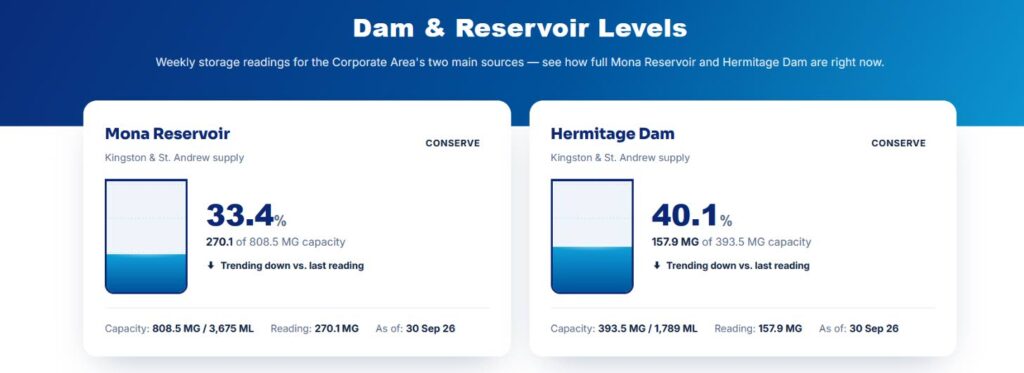
“A year or two ago, you would have noted that most of our problems were on the western side. So, Negril and those areas would have been severely impacted by drought. Now, what is happening this year is that the drought has pretty much moved to greatly impact the KSA (Kingston and St Andrew municipality) side, where our dam levels currently, Hermitage is at 40.2 [per cent], Mona at 33.7 [per cent], and Seaview [water treatment plant] are also severely impacted outside of what they would be producing normally,” she added.
Campbell-Francis explained that although eastern parishes are hardest hit, the water shortage remains an islandwide issue, noting that the NWC’s water supply is also relied on by some non-customers.
“Although we are not in every nook and cranny of Jamaica, our coverage is at 75 per cent [and] we find that as it relates to drought impact, there are some non-service areas that are also served by the NWC system as people will move to get water from those communities. And so, when there is a drought, the entire island is impacted,” she said.

The water levels at the Hermitage Dam in St Andrew, seen critically low on August 12. (Photo: JIS)
Compounding the drought crisis, Campbell-Francis noted that consistently high non-revenue water (NRW) levels remain one of the greatest challenges facing the NWC. She explained that NRW — treated water that is produced and pumped but lost to leaks or theft before reaching billed customers — accounts for roughly 70 per cent of the utility’s water supply. She noted, however, that the NWC has undertaken several projects to reduce its occurrence, pointing out that the NRW figure in Kingston and St Andrew, as well as Portmore, has been down to between 38 and 40 per cent. “As it relates to where we’re going with NRW, the NWC is in the process of going through an islandwide NRW programme. Now, this programme is supposed to last for seven [to] 11 years. The first year is primarily auditing. The next five years, we’ll be focusing on works, and then the next five years, maintenance. “What we are expecting is that we will be able to move NRW down from the current 70 per cent all the way down to 30 per cent, and we have already started some of those works. We’re in procurement, so we expect that by 2027-2028, the auditing and some initial works will commence,” said Campbell-Francis. As for navigating the current water crisis, Campbell-Francis told the webinar that the NWC is committed to assisting its customers and urged the public to manage their water storage for the days or the hours that they may be out of service. “The most important thing for us during this period is to ensure that as we deliver service, every customer is served. What we have been doing to ensure that our customers are properly served, we have been recommissioning our resting wells, we have been trucking water, and we’ve been also pumping in areas where we have been gravity feeding before. “So, the NWC is serious about ensuring that our customers are served in this time, and also to ensure that we are building resilience for the future, as demonstrated in the projects that we are noting to improve reliability,” she said.