Caribbean News
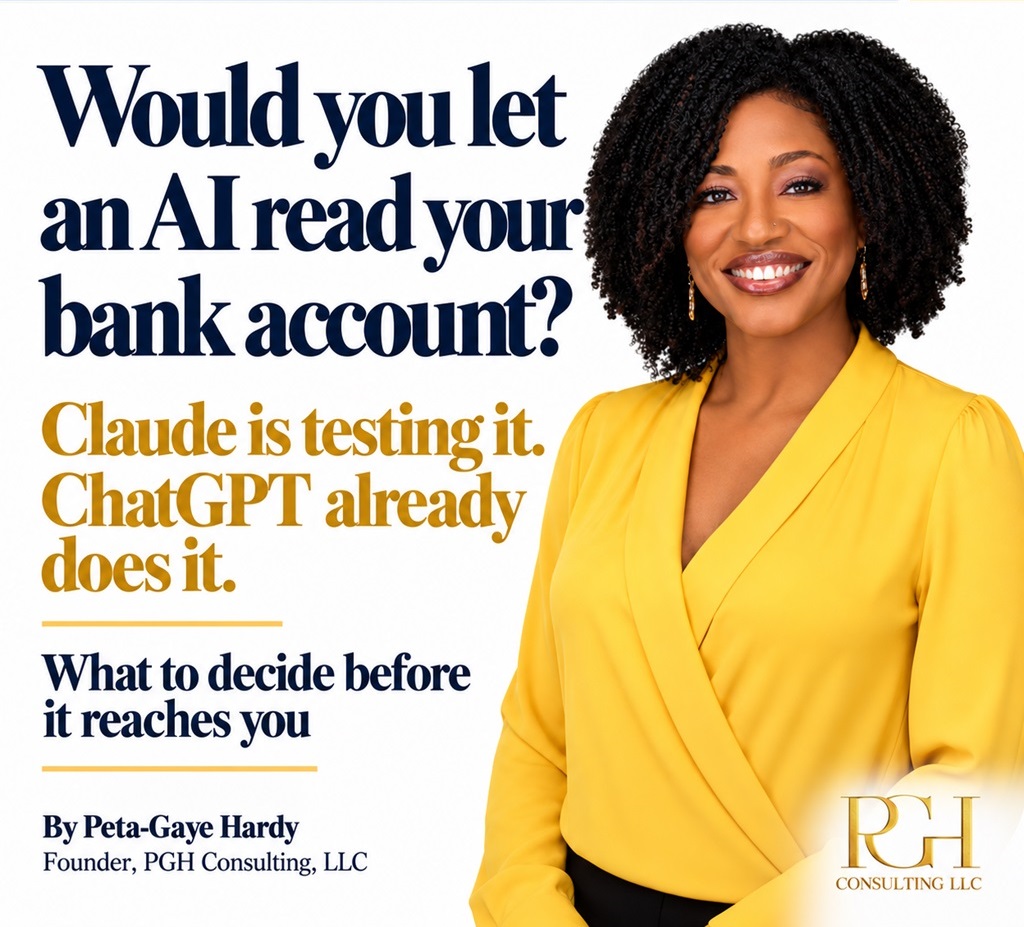
Would you let an AI read your bank account?
Sep 25, 2026 · Peta-Gaye Hardy, Founder, PGH Consulting, LLC
Originally published by Jamaica Observer Read the original
On 14 September a website that tracks unreleased app features published screenshots of a new section inside Claude’s iPhone app. It is labelled Money, it sits alongside Chats and the other tabs, and its opening screen reads: “Understand your money with Claude. Link your bank accounts and ask Claude about spending, plans, and more.” The press has taken to calling it Claude Money. Anthropic had not commented at the time of writing. It is not in the web version, it is not switched on for ordinary users, and nobody outside the company knows which countries or banks it will support.
That would be a thin story on its own. It is worth a column because of what it follows. In May, OpenAI launched Finances in ChatGPT for Pro subscribers in the United States and extended it to Plus in late June. It lets them connect bank, card and investment accounts through Plaid, a service that links to more than 12,000 financial institutions, and then ask questions like “has my spending changed recently?” and “which subscriptions am I still paying for?” The two largest AI companies in the world are now both heading into your bank account, and the direction is settled even if the details are not.
Nothing here is available to a Jamaican bank account today. That is the point of writing about it now.
It reads transactions, categorises spending, tracks balances and subscriptions and answers
questions in plain language. It does not move money, pay bills, make trades, change account settings or
replace your adviser. (Branded graphic by PGH Consulting, LLC)
What the feature actually does, and does not
The best guide to what Claude Money will look like is the version that already exists, because OpenAI has published its rules in full.
Finances in ChatGPT reads. It categorises transactions, tracks spending patterns and subscriptions, monitors balances and net worth, reviews an investment portfolio and explains what drives a credit score. It then answers questions about all of that in plain language, which is the part people find useful: not a dashboard, but a conversation about the dashboard.
It does not act. OpenAI’s help page lists what the feature cannot do, and the list is long by design: it cannot move money, pay bills, change account settings, make trades, change retirement contributions, open or close accounts, file taxes, or act as your financial, legal, tax or investment adviser. It is a reader with a good memory, not a hand on the till.
Two other rules matter. When you disconnect an account, synced data is deleted from OpenAI’s systems within 30 days. And your Finances conversations follow the same model-training setting you have chosen for the rest of ChatGPT, which means that if you have left the default on, what you discuss about your money is treated the same way as anything else you type.
Claude’s version has published none of this yet. Anthropic’s consumer accounts have a similar training setting, and its current position is that raw content pulled in through connectors is excluded from training, though anything copied into the conversation itself is not. It has not said whether linked financial data would be classed as connector content. Until it does, the fair assumption is that you do not know.
Connect a personal account and the feature sees mostly one person’s spending. Connect the
business account and it sees payroll, suppliers, customer transfers, loan repayments and when cash runs tight. (Branded graphic by PGH Consulting, LLC)
The question for a business is different from the question for a person
Both features are personal finance products. They are built for the individual looking at a current account and a credit card, and everything about the design says so: the questions, the categories, the memory of your goals.
That is where a small business owner should stop and think, because in a great many businesses the line between the personal account and the operating account is thin. The owner’s card pays for the stock, the business account pays the household, and a single phone holds the banking app for both.
Connect a personal account and you are sharing one person’s spending. Connect the account the business runs on and you are handing over the payroll, every supplier, every customer who pays by transfer, the loan repayment schedule and the pattern of when the account runs tight. Transaction descriptions are surprisingly revealing. Rachel Tobac, an ethical hacker who runs SocialProof Security, has warned against linking bank accounts to AI tools because they become “a one-stop shop for attackers looking to drain your accounts,” and whatever you think of that phrasing, the attacker’s version of your business would be assembled from exactly the data you would be connecting.
There is a plainer objection. These are consumer features on consumer plans. A business that has moved its people onto a company account, which this column has argued for since the ChatGPT advertising piece, would be reintroducing personal-plan terms into company data through the back door.
Use a statement, not a live bank link: export three months as a CSV, remove sensitive columns,
upload to your company AI plan, ask questions, then delete the file. (Branded graphic by PGH Consulting, LLC)
What you can do today, without connecting anything
The useful part of these features, the conversation about your money, does not require a live link to your bank. It requires a statement.
Export the last three months from your online banking as a CSV. Open it, delete the columns you do not want an AI to see (account numbers, counterparty account details, anything you would not put in an email), and save the trimmed file. Upload it to a project or a chat on the business plan you already pay for, and ask the same questions the feature would answer: which payments recur, what changed this quarter, which suppliers have crept up, where the balance came closest to zero and why.
You will get most of the value of a connected account, and you will have decided, line by line, what the tool sees. When the file is no longer needed, delete it from the project. There is no aggregator in the middle, no standing permission to your bank, and no question about which country’s rules apply, because nothing left your control except a file you edited first.
This is slower than tapping “link account.” It is also the version a business can defend to an accountant, a partner or a customer who asks where their payment details went.
What these features will not do for you
They will not check the bank’s arithmetic. A categorised feed can be wrong in the same way a model can be wrong anywhere else: a supplier filed under the wrong heading, a refund counted as income, a recurring charge missed because the description changed. Every summary is a starting point for a question, not a reconciliation.
They will not replace the bookkeeping. Knowing that spending rose 14 per cent is not the same as knowing why, and the why still lives in your invoices and your decisions.
And they will not arrive here first. Plaid covers banks in the United States, Canada, the United Kingdom and Europe, not the Caribbean, and OpenAI has switched on US accounts only; Anthropic is expected to start in the United States as well. A reader with a US account, and many businesses here have one, could see this sooner than a reader with only local accounts. Either way, the terms will be published before the button reaches you, and the time to read them is then.
Decide which accounts you would ever connect, test one with a trimmed CSV, check data
controls if you already use ChatGPT Finances, find where personal and business money overlap, and
read the data terms before you connect anything. (Branded graphic by PGH Consulting, LLC)
What to try this week
1. Decide now, in one sentence, which accounts you would ever connect to an AI tool and which you would not. Write it down before the feature exists, when the answer is easier.
2. Run the export routine on one business account: three months as a CSV, sensitive columns removed, uploaded to your company AI plan, five questions asked. Note what it got right and what it got wrong.
3. If you or your staff already use Finances in ChatGPT on a US account, check the model-training setting under Data controls and read the list of what the feature cannot do.
4. Look at where personal and business money overlap in your own set-up: shared cards, shared phones, shared logins. Each overlap is a place a personal-finance feature would see business data.
5. Set a reminder for the day Claude Money is announced. Read the published data terms that day and compare them with OpenAI’s 30-day deletion rule and the training setting before deciding anything.
The feature the press has dubbed Claude Money is unannounced and its features, countries and data terms are unknown at the time of writing; the description of ChatGPT Finances is from OpenAI’s published help documentation as at 24 September 2026. Neither feature is available for Jamaican bank accounts. Anything an AI tool reports about your money should be checked against the statement before it is acted on.
Peta-Gaye Hardy is the founder of PGH Consulting, LLC, where she helps finance and operations teams adopt AI in practical, low-risk ways. She writes the weekly AI in Finance & Business column and is based between Jamaica and the United States. Learn more at www.pghconsultinggroup.com. Follow on Instagram and YouTube @pghconsultinggroup, and connect on LinkedIn at linkedin.com/in/peta-gaye-hardy.
Disclosures: This article is informational and does not constitute investment, tax, legal, or accounting advice. Readers should consult a qualified professional before acting. Product features, plan availability and data-handling terms are as published by OpenAI and as reported for Anthropic at the time of writing, and are subject to change; readers should confirm the current position on the vendors’ own pages before connecting any account. AI tools can produce errors, and every figure, clause, or claim they produce should be verified against a source before being shared or acted upon. The author has no commercial relationship with OpenAI, Anthropic, Plaid or any product mentioned and was not compensated by them. All product names, logos, and trademarks are the property of their respective owners and are referenced for editorial purposes. The examples described are illustrative and do not depict any real business.